
Casual educators in early childhood services are paid under the Children’s Services Award, with rates that reflect both their classification level and the 25% casual loading. This ensures they receive higher hourly pay compared to permanent staff, though without entitlements like paid leave.
Role of Casual Educators
Casual educators provide flexible staffing support across early childhood services, filling gaps in rosters, covering absences, and assisting during peak enrolment periods. They are vital for maintaining ratios and ensuring continuity of care.
Casual Pay Rates
Pay rates include 25% loading. The following pay rates are effective from 01 July 2026: 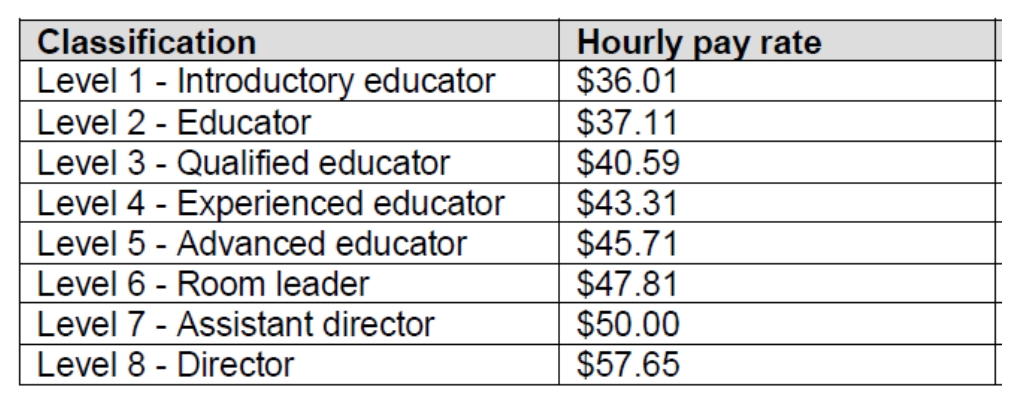
Level Classifications
From 2026, educators move into a simplified 8-level structure. For example:
- Level 1 = Less than 12 months experience
- Level 2 = After 12 months experience and partial qualification progress.
-
Level 3 = Certificate III qualified educator
-
Level 4 = Experienced Certificate III (4+ years post-qualification)
-
Level 5 = Diploma-qualified educator
-
Level 6–8 = Leadership roles (Room Leader, Assistant Director, Director)
Key Differences: Casual vs Permanent
-
Casual loading: 25% extra pay per hour.
-
No entitlements: Casuals do not receive paid annual leave, sick leave, or notice of termination.
-
Flexibility: Casuals can accept or decline shifts but lack guaranteed hours.
-
Conversion rights: After 12 months, casuals may request conversion to permanent employment if regular hours are worked.
Practical Implications
-
Casual educators often earn more per hour than permanent staff but may have less income stability.
-
Services rely on casuals to maintain compliance with staff-to-child ratios.
-
Casual work is common for students, new graduates, or those balancing multiple commitments.
Further Reading
Understanding Your New Classification Level in the Children’s Services Award From 2026
Working As A Casual Educator In Childcare
Updates and Changes To Casual Educator Entitlements
Childcare Wages In Australia




 The Children’s Services Award introduces a streamlined classification system and updated pay rates designed to better recognise the skills, qualifications, and responsibilities of early childhood
 The Children’s Services Award has 8 clear levels. These levels make it easier to understand where you fit, based on your experience, qualifications, and responsibilities.
 When working as a qualified early childhood teacher (with a university degree) within a service, your rate of pay will come from the Educational Services
 Diploma-qualified educators play a vital role in early childhood services, taking on responsibilities that range from supporting children’s learning and development to leading rooms and
 Certificate III qualified educators form the backbone of early childhood services, providing essential care and learning support for children across all settings. Their wages under
 Early Childhood Teachers (ECTs) play a vital role in leading curriculum and pedagogy in early learning settings. Regulation 272 of the Education and Care Services
 Discover how school readiness programs support children’s independence, confidence, and skills for a successful transition into primary school.
 When an Educator is not performing their tasks or responsibilities at best practice, these issues need to be addressed for the Educator to understand where
 Educators can maximise tax deductions by claiming classroom supplies, training, union fees, and home office costs this financial year.
 A staff appraisal is a formal, systematic process of determining and reviewing the performance of early childhood educators over a period of time, usually a