
Diploma-qualified educators play a vital role in early childhood services, taking on responsibilities that range from supporting children’s learning and development to leading rooms and coordinating programs. Their wages under the Children’s Services Award reflect both their qualifications and the scope of their duties, with clear progression as they move into leadership and management roles.
Updated Classification for Diploma Educators (2026 Onwards)
Diploma-qualified educators will move into streamlined levels under the Children’s Services Award from 2026:
- CSE Level 5 (Advanced Educator – Diploma Assistant)
- CSE Level 6 (Room Leader)
- CSE Level 7 (Assistant Director/Coordinator).
Previous levels include:
| Old Level (2010 Award) | Role/Description | New CSE Level (2026) | New Title |
|---|---|---|---|
| Level 3.4 | Diploma-qualified assistant educator | CSE Level 5 | Advanced Educator (Diploma) |
| Level 4.1–4.3 | Newly qualified Diploma educator, progressing through years of experience | CSE Level 6 | Room Leader |
| Level 5.1–5.3 | Assistant Director, Coordinator, Family Day Care Supervisor | CSE Level 7 | Assistant Director / Coordinator |
Key Changes for Diploma Educators
-
Progression Pathway:
-
Start as Advanced Educator (Diploma Assistant) at CSE 5.
-
Move into Room Leader roles at CSE 6.
-
Progress into Assistant Director/Coordinator positions at CSE 7.
-
-
Pay Rates: Each CSE level has its own minimum wage, rising annually with Award increases and gender equity adjustments.
-
Clarity: Educators can now easily identify where they fit without navigating 30+ levels.
What This Means Practically
-
Diploma-qualified assistants will now be recognised as Advanced Educators at CSE 5.
-
Room Leaders are consolidated into CSE 6, acknowledging leadership responsibilities.
-
Assistant Directors/Coordinators (previously Level 5.1–5.3) are now CSE 7, reflecting management duties.
Diploma Qualified Pay Rates
Pay rates for Diploma educators increase at each stage of responsibility, ensuring recognition for advanced skills and leadership within early childhood settings. The following pay rates are effective from 01 July 2026: 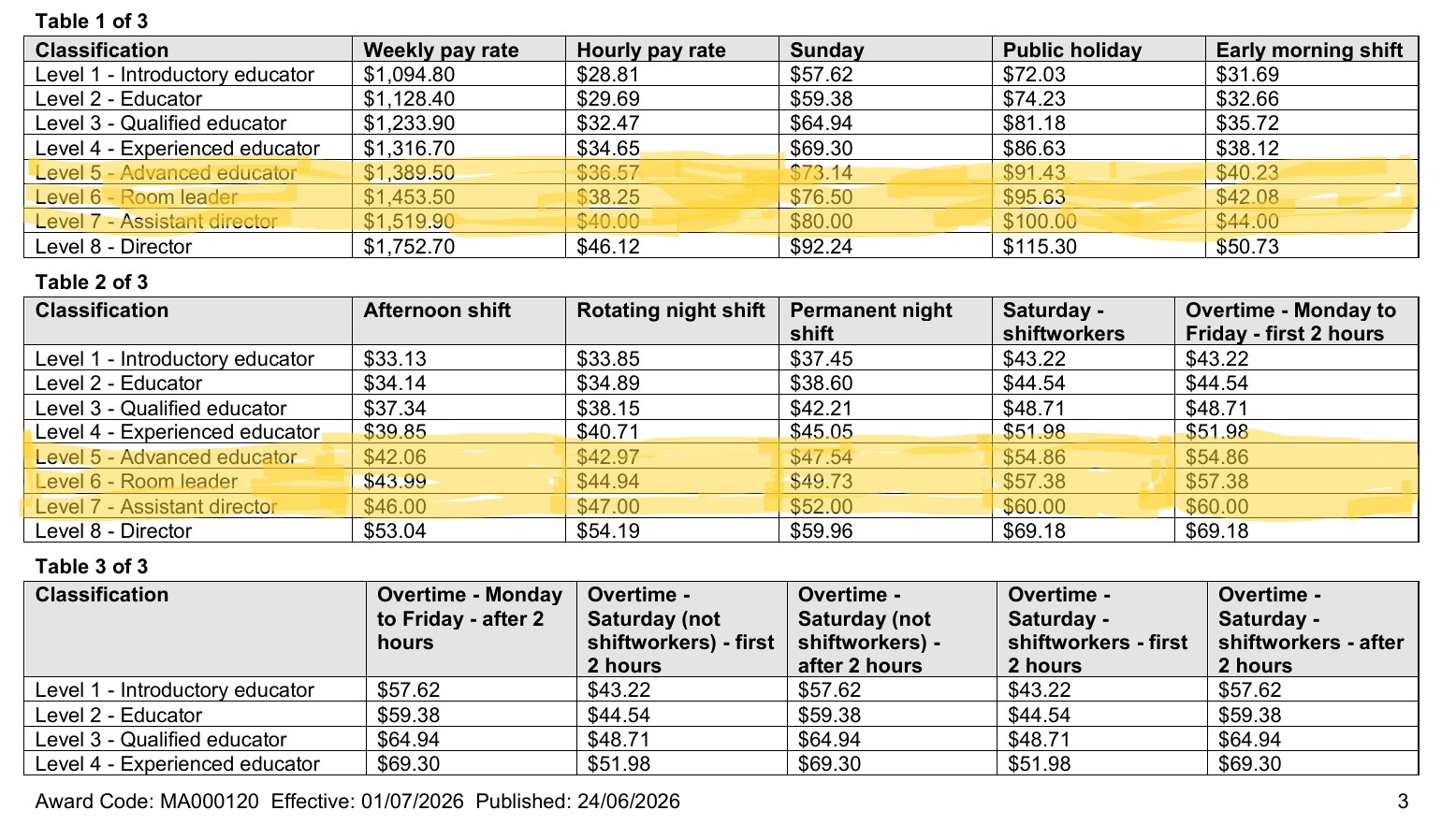
Further Reading
Understanding Your New Classification Level
Increase Pay Rates and New Classification Structure
Understanding the Wage Increase and Retention Payment




 The Children’s Services Award introduces a streamlined classification system and updated pay rates designed to better recognise the skills, qualifications, and responsibilities of early childhood
 The Children’s Services Award has 8 clear levels. These levels make it easier to understand where you fit, based on your experience, qualifications, and responsibilities.
 When working as a qualified early childhood teacher (with a university degree) within a service, your rate of pay will come from the Educational Services
 Diploma-qualified educators play a vital role in early childhood services, taking on responsibilities that range from supporting children’s learning and development to leading rooms and
 Certificate III qualified educators form the backbone of early childhood services, providing essential care and learning support for children across all settings. Their wages under
 Early Childhood Teachers (ECTs) play a vital role in leading curriculum and pedagogy in early learning settings. Regulation 272 of the Education and Care Services
 Discover how school readiness programs support children’s independence, confidence, and skills for a successful transition into primary school.
 When an Educator is not performing their tasks or responsibilities at best practice, these issues need to be addressed for the Educator to understand where
 Educators can maximise tax deductions by claiming classroom supplies, training, union fees, and home office costs this financial year.
 A staff appraisal is a formal, systematic process of determining and reviewing the performance of early childhood educators over a period of time, usually a