Children love bright colours. Rainbow science experiments engage curiosity, teach absorption, density, and refraction, and make learning fun.
Children are naturally drawn to bright, vivid colours, which makes rainbow-themed science experiments instantly engaging and relatable. Because colours are part of their everyday world—seen in toys, clothes, art, and nature—rainbow experiments provide a familiar entry point into scientific exploration.
These activities spark curiosity and wonder by showing how ordinary materials can transform into extraordinary displays of colour. Whether it’s watching water “walk” across paper towels, seeing milk swirl into rainbow patterns, or layering liquids into a colourful tower, children experience science as something magical yet understandable.
Benefits For Children
Rainbow experiments also encourage the following:
-
Exploration: Children test, observe, and discover how colours move, mix, and change.
-
Prediction & Problem-Solving: They guess outcomes and compare them with real results.
-
Connection to Real Science: Concepts like absorption, density, and light refraction are introduced in playful, age-appropriate ways.
-
Creativity & Identity: Just as every rainbow includes many colors, these experiments celebrate diversity and encourage children to see themselves as scientists.
Photo Ideas




Rainbow Science Experiment Recipes
| Experiment | Ingredients | What to Do | Science Behind It |
|---|---|---|---|
| Capillary Action with Paper Towels (Rainbow Jars) | Glass jars, water, food coloring (red, orange, yellow, green, blue, purple), paper towels | Fill jars with colored water, and place paper towels bridging between jars. Wait as colors travel and mix. | Capillary action pulls water upward through paper fibers; water moves from one jar to another, mixing colors. |
| Plant Dye Absorption (Lettuce/Cabbage Leaves) | Glasses, water, food coloring (various colors), lettuce/cabbage leaves | Place leaves in glasses of colored water. Observe over hours/days. | Plants transport water through xylem vessels; dye travels with water, coloring leaves. |
| Carnations in Colored Soda Bottles | Soda bottles, carnations, food coloring or colored drinks | Place carnations in bottles of colored liquid. Watch petals change color. | Same principle as above: capillary action in xylem moves dyed water into petals. |
| Borax Crystal Stars (Pipe Cleaner Ornaments) | Pipe cleaners, borax, boiling water, food coloring, jars, string | Shape pipe cleaners into stars, and suspend them in borax solution overnight. Crystals grow on pipe cleaners. | Supersaturated solution deposits borax crystals as water cools and evaporates. |
| Fizzing Colors (Baking Soda & Vinegar Reaction) | Baking soda, vinegar, food coloring, droppers, tray | Spread baking soda and drop colored vinegar onto it. Watch fizzing foam. | Acid-base reaction: vinegar (acid) + baking soda (base) → carbon dioxide bubbles + water + salt. |
| Bubble Snake Blower | Plastic bottle, cloth, rubber band, dish soap, food coloring | Cut the bottle bottom, attach cloth, dip in soap solution, and blow through the top. | Soap film traps air; blowing creates bubbles. Food coloring adds a rainbow effect. |
| Skittles Rainbow Plate | Skittles, plate, warm water | Arrange Skittles in a circle, and pour water. Colors diffuse inward. | Sugar and dye dissolve, and diffusion spreads colors evenly toward center. |
| Rainbow Rain (Shaving Cream Cloud) | Clear container, water, shaving cream, food coloring | Fill the container with water, add a shaving cream “cloud,” and drop food coloring on top. | Shaving cream acts as a cloud; dye diffuses through cream into water, mimicking rain. |
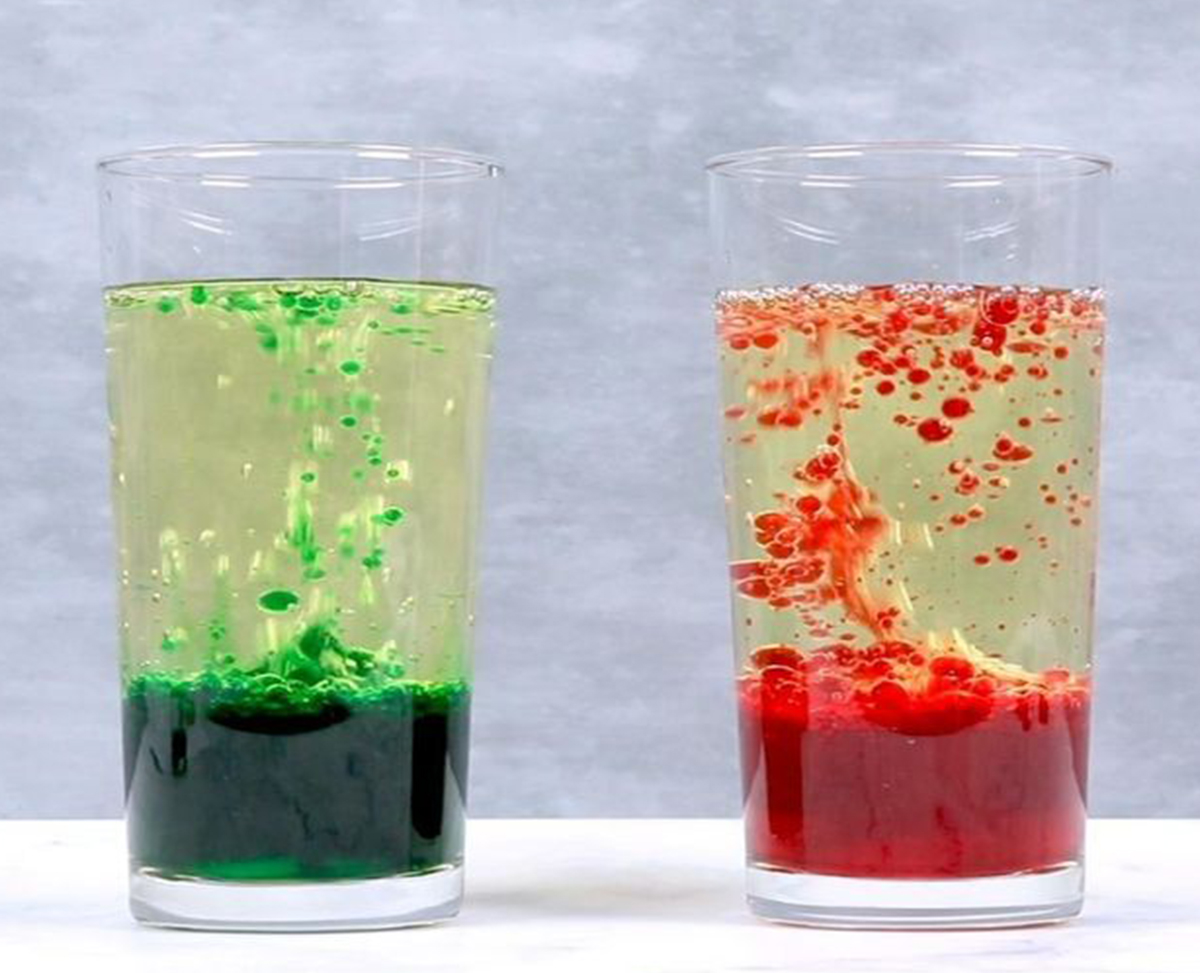
| Oil & Water Density Experiment | Tall glasses, oil, food coloring, water | Fill glasses with oil, add drops of colored water. Watch them sink. | Oil and water are immiscible; water is denser, so it sinks, forming patterns. |
| Rock Candy Crystals in Jars | Jars, sugar, water, food coloring, sticks | Make a supersaturated sugar solution, pour it into jars, and suspend sticks. Crystals grow over days. | Sugar molecules form solid crystals as the solution cools and evaporates. |
| DIY Bouncy Balls | Cornstarch, borax, water, food coloring | Mix the borax solution, add cornstarch and glue, and knead until a ball forms. | Polymer chains cross-link, creating elastic material that bounces. |
| Resin/Glue Glitter Ornaments (Suncatchers) | Clear glue or resin, food coloring, glitter, molds | Mix glue/resin with colors and glitter, pour into moulds, let dry. | Resin/glue hardens, trapping glitter and dye, creating a marbled decorative effect. |
By linking the joy of colour with scientific processes, rainbow experiments become a powerful tool for building curiosity, confidence, and a love of learning—perfectly aligned with the spirit of the International Day of Women and Girls in Science, which celebrates inclusion and the idea that science is for everyone.
Image References
Image 1 - Megan Sheakoski: Coffee Cups and Crayons, Pinterest
Image 2 - Chu Pornpimon, Pinterest
Image 3 - No Name, Pinterest
Image 4 - One Little Project, Pinterest
Image 5 - Anya Garcia | Building Humanity Early™, Pinterest
Image 6 - Pamela Seligsohn, Pinterest
Image 7 - The Best Ideas for Kids, Pinterest
Image 9 - Hana, Pinterest
Image 10 - No Name, Pinterest
Image 11 - Keep This recipe | Easy recipes & creative DIY crafts, Pinterest
Further Reading
International Day of Women and Girls in Science Activities For Children
Rainbow Walking On Water
Rainbow Fireworks In A Jar
Rainbow Paper
Rainbow Crystal Garden
Easy Science Experiments For Toddlers and Preschoolers
30 Preschool Science Activities Aligned With EYLF
 Open ended questions cannot be responded to with one word answers such as yes or no. These types of questions enables a child to provide
 During your child’s preschool years, an important milestone begins to emerge. This is the development of pre-writing skills. Pre-writing skills are used to encourage, develop
 An Acknowledgment of the Country is a way of showing respect for the Traditional Owners and can be given by both non-Indigenous people and Aboriginal
 Open ended materials enables children to play freely. They are objects that have no rules to follow, use or function. Raw materials that can be
 Language plays an important role in a child’s development. It enables a child to communicate effectively with their family, learn at school, socialize with friends,
 Like adults, children have to deal with their own stress in life. Moving house, starting a new school, preparing for a new sibling - these are
 Playdough is such a versatile material. It provides numerous benefits to children as they manipulate it, it is safe and soothing and provides children with
 Teaching children about sustainability enables them to appreciate and respect the natural environment. Early childhood services can provide meaningful hand on learning experiences in order
 Recycling is an important concept that teaches children to care for the environment. It encourages children to be responsible and show a growing appreciating for
 Incursions provide children with the opportunity to explore meaningful learning experiences in the comfort of their early childhood service. The following provides a directory of