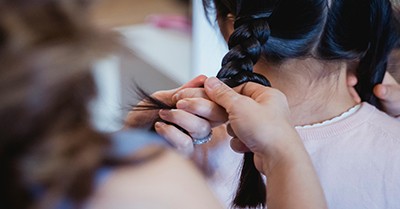
A: Something as simple as a child asking to braid an educator’s hair—or children braiding each other’s can spark important questions about connection, trust, and professional boundaries. For many, braiding is more than a playful activity; it is a gesture of closeness, a way of forming relationships, and in some cultures, a practice rich with tradition and identity.
At the same time, educators must balance these relational opportunities with health, hygiene, and safety considerations, ensuring that practices in the service align with professional standards and family expectations. This tension—between fostering connection and maintaining boundaries—makes hair braiding a valuable topic for reflection in early learning settings.
Braiding as a Relational Practice
-
Trust and Care: Allowing someone to touch your hair is intimate. When children invite educators to braid their hair (or vice versa), it can signal trust, comfort, and a sense of belonging.
-
Social Bonding: Among peers, braiding often becomes a form of play and friendship. It’s a way children express care for one another.
-
Cultural Continuity: In many cultures, hair braiding is a traditional practice passed down through generations. Sharing this in an early learning service can affirm children’s identities and family traditions.
-
Emotional Connection: The quiet, focused nature of braiding can create space for conversation, storytelling, or simply being together—strengthening educator-child relationships.
Key Considerations
-
Health & Hygiene
- Hair braiding can increase the risk of head lice transmission and other hygiene concerns.
- Children’s hands may not be clean, and touching hair can spread germs.
-
Safety & Wellbeing
- Tight braids can cause discomfort or scalp irritation.
- Pulling or accidental tangling could lead to minor injuries.
- Some children may not understand personal boundaries, so consent and comfort are critical.
-
Professional Boundaries
- Educators engaging in hair braiding may blur the line between professional care and personal grooming.
- Many services discourage staff from styling children’s hair to avoid misunderstandings with families.
-
Cultural Sensitivity
- Hair can carry cultural, religious, or personal significance. What feels like play to one child may feel inappropriate to another.
- Families may have strong views about who is allowed to touch or style their child’s hair.
Best Practice Approach
- Check your service’s policy: Many centres include grooming and hygiene boundaries in their health and safety or staff conduct policies.
- Redirect the play: If children show interest in braiding, offer alternatives like braiding yarn, ribbons, or dolls’ hair instead of each other’s.
- Teach boundaries: Use the moment to discuss consent, personal space, and hygiene in age-appropriate ways.
- Communicate with families: If hair braiding is allowed, families should be informed and comfortable with the practice
- Braiding Ribbons or Yarn: Set up a “braiding station” with colourful threads, beads, or dolls’ hair.
- Storytelling Circles: Use the time children might spend braiding as a chance to sit together, share stories, and build bonds.
- Cultural Showcases: Invite families to share traditional hair practices in a safe, supervised way—celebrating identity without daily hygiene risks.
- Symbolic Activities: Activities like weaving, knot-tying, or collaborative art projects can mimic the intimacy and rhythm of braiding while avoiding health concerns.
Reflection Prompt for Educators
-
How do we honour children’s desire for closeness and connection while maintaining professional boundaries?
-
Can we reframe braiding as a symbol of relationship-building and find safer, inclusive practices that achieve the same emotional outcomes?
In short: braiding can indeed be about forming relationships and connections, but the challenge for educators is to translate that relational intent into safe, inclusive practices.
Most services lean toward not allowing educators to braid children’s hair or children to braid educators’ hair, primarily due to hygiene and professional boundary concerns. Instead, they encourage creative play alternatives that meet the same social and fine-motor needs without the risks.
Further Reading
Strategies To Build Relationships With Children
Forming Relationships With Children In Childcare
Importance Of Relationships Between Families and Educators




 The Children’s Services Award introduces a streamlined classification system and updated pay rates designed to better recognise the skills, qualifications, and responsibilities of early childhood
 The Children’s Services Award has 8 clear levels. These levels make it easier to understand where you fit, based on your experience, qualifications, and responsibilities.
 When working as a qualified early childhood teacher (with a university degree) within a service, your rate of pay will come from the Educational Services
 Diploma-qualified educators play a vital role in early childhood services, taking on responsibilities that range from supporting children’s learning and development to leading rooms and
 Certificate III qualified educators form the backbone of early childhood services, providing essential care and learning support for children across all settings. Their wages under
 Early Childhood Teachers (ECTs) play a vital role in leading curriculum and pedagogy in early learning settings. Regulation 272 of the Education and Care Services
 Discover how school readiness programs support children’s independence, confidence, and skills for a successful transition into primary school.
 When an Educator is not performing their tasks or responsibilities at best practice, these issues need to be addressed for the Educator to understand where
 Educators can maximise tax deductions by claiming classroom supplies, training, union fees, and home office costs this financial year.
 A staff appraisal is a formal, systematic process of determining and reviewing the performance of early childhood educators over a period of time, usually a