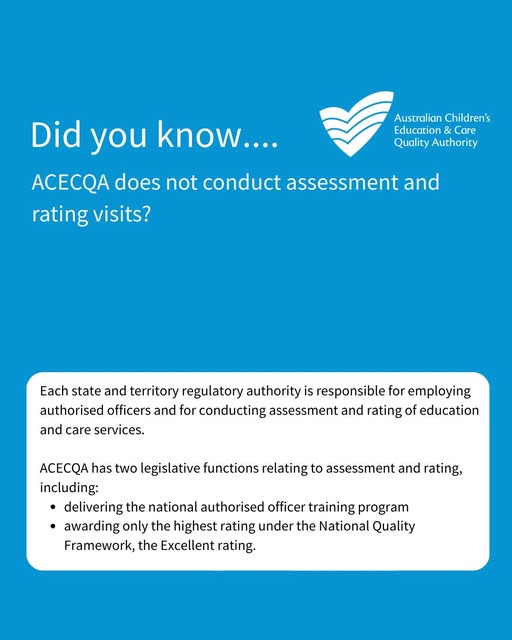
In early childhood education, timing shapes interpretation. A message that would normally pass quietly through the sector can suddenly feel loaded when educators are already carrying frustration, fatigue, and a sense of being unheard. That’s exactly what happened when ACECQA published a routine #funfactfriday post. The post itself was simple and familiar. ACECQA shared a link to one of their infographics, saying, "Did You Know... ACECQA Does Not Conduct Assessment and Rating Visits?
On any other week, this would have been just another resource drop, a neutral, informational post designed to support understanding of the National Quality Framework. But lately it's not like “any other week.” The sector is already buzzing with frustration about assessment pressures, documentation expectations, and the ongoing disconnect between regulatory messaging and lived experience.
So a routine ACECQA post landed in a climate that was anything but routine.
The wording itself was harmless. It wasn’t defensive, corrective, or reactive. It didn’t reference current issues. It didn’t acknowledge sector tension. It didn’t attempt to manage public perception.
But educators didn’t read it in isolation. They read it in context a context shaped by:
-
rising dissatisfaction with assessment and rating experiences
-
confusion about who actually conducts A&R visits
-
frustration with inconsistent expectations across jurisdictions
-
a sense that regulatory bodies are out of touch with day‑to‑day realities
In that emotional landscape, even a simple line like “download and display this infographic in your service” can feel like yet another instruction, another expectation, another reminder of the power imbalance between regulators and educators.
ACECQA’s post wasn’t a response to bad publicity. It wasn’t damage control. It wasn’t an attempt to redirect the narrative. It was a scheduled, predictable piece of content — the kind they publish every week.
But when educators are already feeling overwhelmed, even neutral messaging can land with unintended weight. This is the communication gap the sector keeps running into: the difference between what is said and how it is received.
Regulatory bodies often communicate as though the sector is calm, stable, and well‑resourced. Educators receive those messages while juggling staffing shortages, compliance pressure, and emotional exhaustion.
The disconnect is not in the content it’s in the context.
When trust is strained, timing becomes everything. A routine post can feel like a provocation. A simple infographic can feel like a directive. A neutral reminder can feel like a reprimand.
This isn’t because educators are “overreacting.” It’s because the system has conditioned them to brace for impact.
Until the sector feels genuinely supported, not just regulated, even the most routine ACECQA posts will continue to collide with frustration rather than land as intended.
So What Exactly Does ACECQA Do?
ACECQA plays a national leadership and oversight role in our early childhood education and care system. Rather than conducting assessment and rating visits, ACECQA focuses on supporting quality and consistency by developing national guidance, publishing resources, approving qualifications, analysing sector data, and monitoring how the NQF is implemented in each jurisdiction. They provide tools, training, and information to help educators, services, and regulatory authorities understand and apply the NQF, and they conduct second‑tier reviews when services request a reassessment of their rating. In short, ACECQA sets the national direction, builds capability, and strengthens consistency, but it does not regulate or assess individual services.
Further Reading
Steps in the Assessment and Rating Process
ACECQA-Approved Learning Frameworks Resources
ACECQA Extends Requirement Of Persons Taken To Be ECT
ACECQA Publishes New Guidance Information On QA2
ACECQA Launches Risk Assessment and Management Tool
Reference:
ACECQA Facebook



 The Children’s Services Award introduces a streamlined classification system and updated pay rates designed to better recognise the skills, qualifications, and responsibilities of early childhood
 The Children’s Services Award has 8 clear levels. These levels make it easier to understand where you fit, based on your experience, qualifications, and responsibilities.
 When working as a qualified early childhood teacher (with a university degree) within a service, your rate of pay will come from the Educational Services
 Diploma-qualified educators play a vital role in early childhood services, taking on responsibilities that range from supporting children’s learning and development to leading rooms and
 Certificate III qualified educators form the backbone of early childhood services, providing essential care and learning support for children across all settings. Their wages under
 Early Childhood Teachers (ECTs) play a vital role in leading curriculum and pedagogy in early learning settings. Regulation 272 of the Education and Care Services
 Discover how school readiness programs support children’s independence, confidence, and skills for a successful transition into primary school.
 When an Educator is not performing their tasks or responsibilities at best practice, these issues need to be addressed for the Educator to understand where
 Educators can maximise tax deductions by claiming classroom supplies, training, union fees, and home office costs this financial year.
 A staff appraisal is a formal, systematic process of determining and reviewing the performance of early childhood educators over a period of time, usually a