



Across the early childhood education and care sector, educators are sounding the alarm: current staffing ratios are insufficient to deliver safe, meaningful, and developmentally appropriate care. While recent reforms have focused on mobile phone bans and child safety protocols, many in the sector argue that these measures overlook a deeper structural issue—chronic understaffing driven by profit-based ratio models.

Dear Supporters,
Thank you for continuing to stand with us in the call to close the “Under the Roof” loophole in early childhood staffing ratios. Your voices have helped bring national attention to a regulatory gap that affects child safety, educator wellbeing, and sector integrity.

In early childhood education, minimum ratios is one of the most insidious drivers of burnout across the sector. When minimum standards become maximum limits, educators are expected to absorb overwhelming cognitive and emotional loads while maintaining composure, care, and compliance. The result? Chronic stress, professional dissonance, and rising attrition. Ratios don’t just affect supervision—they shape every moment of decision-making, relational engagement, and safeguarding. The following article provides research on the effect of ratios on educators.

Here’s a curated set of critical reflection questions designed to provoke deep thinking around educator-to-child ratios in early childhood settings.

In early childhood education and care, ratios are more than a technicality—they are a frontline safeguard. Every child deserves responsive supervision, emotional connection, and developmental support. Yet in Australia, the current staff-to-child ratio standards may meet regulatory requirements, but they fall short of protecting what matters most: children's safety and well-being.
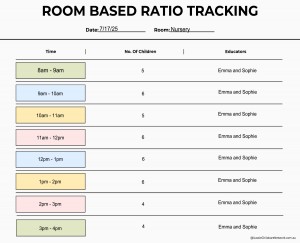
This template can be used for a targeted supervision strategy.

Across Australia, regulated staffing ratios aim to safeguard children in early learning settings. However, a growing number of incidents reveal that meeting these minimum requirements on paper doesn’t always translate into active, vigilant supervision. Below are several case studies that illustrate how gaps can emerge—even when legal ratios are nominally met.

Recent charges against two childcare workers in Western Sydney have reignited critical conversations about child safety, supervision practices, and compliance structures in early learning centers. On June 26, a 17-month-old child was allegedly assaulted twice in separate incidents on the same day—each involving a different educator—raising concerns about how such occurrences go undetected.
We’ve built a sector where “under the roof” staffing logic can mask supervision breakdowns. Where ratios are met on paper, but no one is actively watching. Where a child can be harmed twice in one day—and no one notices until it’s too late.
We need to stop pretending that minimum standards are enough. Because they’re not. Children deserve active supervision, not passive headcounts. Educators deserve clear protocols, not vague staffing models.
The “under the roof” rule allows childcare centres to meet staffing ratios by counting all educators on-site, regardless of whether they are physically present in rooms with children. This means a centre may appear compliant on paper, even if individual rooms are understaffed.While originally intended to offer flexibility, educators say it’s now being used to cut corners—leaving children without adequate supervision and educators stretched beyond capacity.

A recent survey conducted by the United Workers Union (UWU) has revealed a troubling reality in Australia’s early childhood education sector: 77% of childcare workers report that their centres operate below minimum staffing levels at least once a week, with 42% saying this occurs daily.
 The Children’s Services Award introduces a streamlined classification system and updated pay rates designed to better recognise the skills, qualifications, and responsibilities of early childhood… Read More
 The Children’s Services Award has 8 clear levels. These levels make it easier to understand where you fit, based on your experience, qualifications, and responsibilities.… Read More
 When working as a qualified early childhood teacher (with a university degree) within a service, your rate of pay will come from the Educational Services… Read More
 Diploma-qualified educators play a vital role in early childhood services, taking on responsibilities that range from supporting children’s learning and development to leading rooms and… Read More
 Certificate III qualified educators form the backbone of early childhood services, providing essential care and learning support for children across all settings. Their wages under… Read More
 Early Childhood Teachers (ECTs) play a vital role in leading curriculum and pedagogy in early learning settings. Regulation 272 of the Education and Care Services… Read More
 Discover how school readiness programs support children’s independence, confidence, and skills for a successful transition into primary school.
Read More
Discover how school readiness programs support children’s independence, confidence, and skills for a successful transition into primary school.
Read More
 When an Educator is not performing their tasks or responsibilities at best practice, these issues need to be addressed for the Educator to understand where… Read More
 Educators can maximise tax deductions by claiming classroom supplies, training, union fees, and home office costs this financial year.
Read More
Educators can maximise tax deductions by claiming classroom supplies, training, union fees, and home office costs this financial year.
Read More
 A staff appraisal is a formal, systematic process of determining and reviewing the performance of early childhood educators over a period of time, usually a… Read More

No-bake cookies are a fantastic way to get children involved in the kitchen without the...
See more...
A yarning circle is the practice of speaking and listening from the heart, for sitting...
See more...
Protected disclosures in NSW childcare safeguard educators, uphold integrity, and strengthen trust in early education...
See more...