



According to respondents to a 7.30 inquiry, a technique at early childhood services known as "under the roof"—which determines the ratio of Educators to children—is being misused.

Children need safe and positive environments to learn and grow. To ensure this, services and educators need to ensure effective supervision at all times. The following article provides information on the different aspects of supervision, ranging from regulatory requirements and principles to practice strategies.
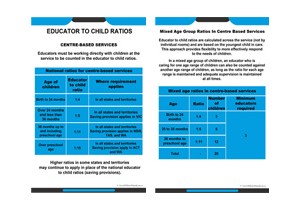
The Educator To Child Ratio Posters includes the educator to child ratios in a centre-based service for each age group and in a mixed age group. Minimum educator-to-child ratios and purposeful for services to highlight the importance of the safety, welfare and wellbeing of children and for Educators to effectively supervise children within the environment. These posters will be good to display within the service for Educators and families to view.

The Staff Ratios and Adequate Supervision information, for NSW early childhood services, has been revised and updated by the NSW Regulatory Authority, NSW Department Of Education.

In a mixed age group of children, an educator who is caring for one age range of children can also be counted against another age range of children, as long as the ratio for each age range is maintained and adequate supervision is maintained at all times.

For centre-based services, some centres calculate ratios across the whole service, not by individual rooms. The term used is "under the roof".
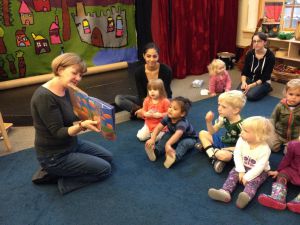
Minimum educator-to-child ratios and purposeful for services to highlight the importance of the safety, welfare and wellbeing of children and for Educators to effectively supervise children within the environment.
 The Children’s Services Award introduces a streamlined classification system and updated pay rates designed to better recognise the skills, qualifications, and responsibilities of early childhood… Read More
 The Children’s Services Award has 8 clear levels. These levels make it easier to understand where you fit, based on your experience, qualifications, and responsibilities.… Read More
 When working as a qualified early childhood teacher (with a university degree) within a service, your rate of pay will come from the Educational Services… Read More
 Diploma-qualified educators play a vital role in early childhood services, taking on responsibilities that range from supporting children’s learning and development to leading rooms and… Read More
 Certificate III qualified educators form the backbone of early childhood services, providing essential care and learning support for children across all settings. Their wages under… Read More
 Early Childhood Teachers (ECTs) play a vital role in leading curriculum and pedagogy in early learning settings. Regulation 272 of the Education and Care Services… Read More
 Discover how school readiness programs support children’s independence, confidence, and skills for a successful transition into primary school.
Read More
Discover how school readiness programs support children’s independence, confidence, and skills for a successful transition into primary school.
Read More
 When an Educator is not performing their tasks or responsibilities at best practice, these issues need to be addressed for the Educator to understand where… Read More
 Educators can maximise tax deductions by claiming classroom supplies, training, union fees, and home office costs this financial year.
Read More
Educators can maximise tax deductions by claiming classroom supplies, training, union fees, and home office costs this financial year.
Read More
 A staff appraisal is a formal, systematic process of determining and reviewing the performance of early childhood educators over a period of time, usually a… Read More

The following lists the sub-outcomes, examples of evidence when children achieve each sub-outcome and how...
See more...
The theme of this year's Children's Week is Article 24 of the United Nations Convention...
See more...
Drawing is a vital activity for children's development. It helps build the foundation for writing by...
See more...