



The following lists the sub-outcomes, examples of evidence when children achieve each sub-outcome and how educators can promote and help children to achieve EYLF Outcome 2 - Children Are Connected With And Contribute To Their World V2.0.
The following lists the sub outcomes, examples of evidence when children can achieve each sub outcome and how educators can promote and help children to achieve EYLF Learning Outcome 1: Children Have A Strong Sense Of Identity

All Australian, state and territory Education Ministers have now collectively approved updates to Australia’s EYLF and MTOP-approved learning frameworks.

The Educators’ Guide to the Early Years Learning Framework recommends that educators use the cycle of planning to support children’s continual learning and introduce meaningful learning opportunities. The following article provides the steps in the planning cycle.
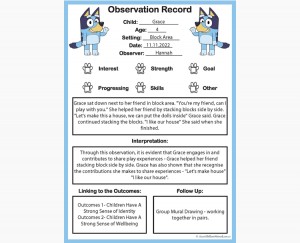
This template is used to record a child's observation efficiently and quickly.

Play provides opportunities for children to learn as they discover, create, improvise and imagine. Creative play in children immerse themselves in their imaginary worlds they become whatever they want to be. Also known as role play, and pretend play, the benefits of creative play range from learning to think in abstractions to social and emotional learning. The following article provides ideas and strategies for incorporating creative play in each individual eylf learning outcomes.

Experts on early childhood education have for some time believed that much more than the content of learning – like numeracy, literacy and science concepts – it is the acquiring of learning dispositions that ensure the best academic outcomes in the long run. The following article provides information on What Are Learning Dispositions, How Dispositions Change over Time and Context, Examples Of Learning Dispositions and more.
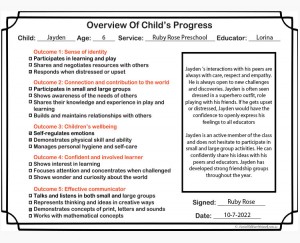
This template is to be used to detail the child's progress over the course of the year. It's great to share with families to let them know specifically how their child developed and the new skills they learnt. It can also be used as a Transition Statement for the child to be shared with the school teacher.
According to EYLF, scaffolding comprises of the educators’ decisions and actions that build on children’s existing knowledge and skills to enhance their learning. In early childhood education, this is one of the most useful learning approaches since it offers guidance when children are learning a skill or concept while also giving them enough room to think and explore on their own. The following article provides information on Scaffolding And Theory, the Benefits Of Scaffolding, the Educator's Role In Scaffolding, Strategies and more.

The EYLF explains assessment for children’s learning as the process of gathering and analysing information as evidence about what children know, can do and understand. It is a key part of an ongoing cycle that includes planning, documenting and evaluating children’s learning. And one of the most effective forms of such documentation is the learning story. The following article provides information on What Is A Learning Story, the Components Of A Learning Story, Writing A Learning Story, What To Include In A Learning Story and more.
 The Children’s Services Award introduces a streamlined classification system and updated pay rates designed to better recognise the skills, qualifications, and responsibilities of early childhood… Read More
 The Children’s Services Award has 8 clear levels. These levels make it easier to understand where you fit, based on your experience, qualifications, and responsibilities.… Read More
 When working as a qualified early childhood teacher (with a university degree) within a service, your rate of pay will come from the Educational Services… Read More
 Diploma-qualified educators play a vital role in early childhood services, taking on responsibilities that range from supporting children’s learning and development to leading rooms and… Read More
 Certificate III qualified educators form the backbone of early childhood services, providing essential care and learning support for children across all settings. Their wages under… Read More
 Early Childhood Teachers (ECTs) play a vital role in leading curriculum and pedagogy in early learning settings. Regulation 272 of the Education and Care Services… Read More
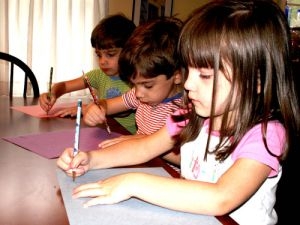 Discover how school readiness programs support children’s independence, confidence, and skills for a successful transition into primary school.
Read More
Discover how school readiness programs support children’s independence, confidence, and skills for a successful transition into primary school.
Read More
 When an Educator is not performing their tasks or responsibilities at best practice, these issues need to be addressed for the Educator to understand where… Read More
 Educators can maximise tax deductions by claiming classroom supplies, training, union fees, and home office costs this financial year.
Read More
Educators can maximise tax deductions by claiming classroom supplies, training, union fees, and home office costs this financial year.
Read More
 A staff appraisal is a formal, systematic process of determining and reviewing the performance of early childhood educators over a period of time, usually a… Read More
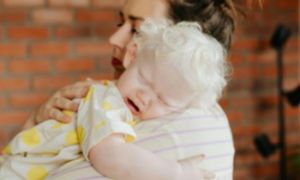
Separation anxiety is a normal developmental stage that often begins around 6–12 months of age...
See more...
Quality Area 6 has two standards that support building collaborative partnerships with families and communities...
See more...
Engaging families in early learning is crucial for fostering a collaborative environment that supports children's...
See more...