


In early childhood education, the words we choose shape how learning is seen, valued, and shared. The EYLF gives us a powerful framework but in the rush of daily practice, it’s easy to lose confidence in linking outcomes or finding the right language to describe children’s learning. That’s where keywords and prompts become transformative.
Using consistent, purposeful language helps educators capture learning clearly and confidently. It supports teams to analyse observations with depth, link meaningfully to outcomes, and plan follow‑ups that honour each child’s identity, culture, and capabilities. Most importantly, it keeps documentation manageable, intentional, and child‑centred.
This article explores how EYLF‑aligned keywords and prompts can streamline your observation cycle, strengthen reflective practice, and bring clarity to everyday planning.

Documentation walls are more than displays—they are living narratives of children’s learning, identity, and community. When aligned with the Early Years Learning Framework (EYLF), they become powerful tools for reflection, family engagement, and sector advocacy. Below are modular, emotionally intelligent wall concepts for each of the five EYLF Learning Outcomes, adaptable to your centre’s style, cultural symbolism, and children’s voices.

Strengths-based documentation is more than a compliance tool, it’s a way of honouring children’s voices, identities, and learning journeys. By mapping affirming, child-centered phrases directly to the EYLF Learning Outcomes, educators can embed the framework naturally into observations, induction processes, and audit preparation. This guide offers a practical cheat sheet tailored to infants, toddlers, and preschoolers, supporting emotionally intelligent practice and sector well-being.
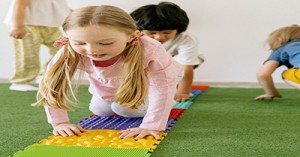
Outcome 3 of the EYLF, Children have a strong sense of well-being, which reminds us that physical health and emotional safety are deeply connected. In early childhood, well-being is expressed through movement, rest, nutrition, emotional regulation, and trusting relationships. The following article translates the outcome into simplified language to support educators in recognising and documenting moments where children care for their bodies, express their feelings, and build resilience.
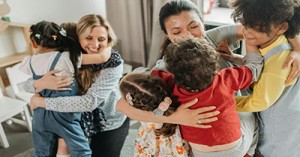
Outcome 2 of the EYLF—Children are connected with and contribute to their world—reminds us that belonging is not just about being present but about feeling valued, included, and empowered to make a difference. The following article translates the outcome into simplified language to support educators in recognising and documenting moments of empathy, cooperation, and community-building.

A child’s sense of identity is the foundation for all learning, relationships, and wellbeing. Outcome 1 of the EYLF Children have a strong sense of identity reminds us that when children feel safe, seen, and valued, they begin to explore who they are and how they belong. The following article translates the outcome into simplified language to support educators in recognising identity-building moments, responding with emotional intelligence, and documenting children’s growth in ways that are meaningful for families and respectful of each child’s unique story.
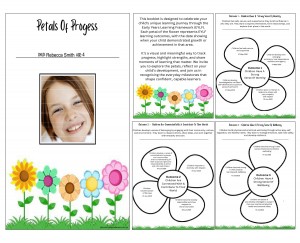
This booklet can be used to track individual progress.
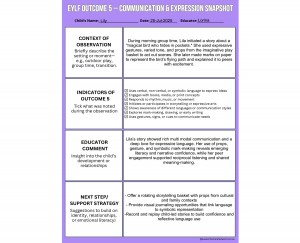
This template can be used as an observation template.
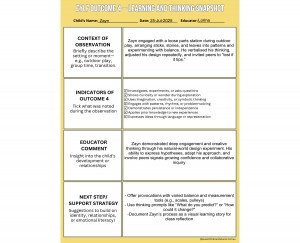
This template can be used as an observation template.
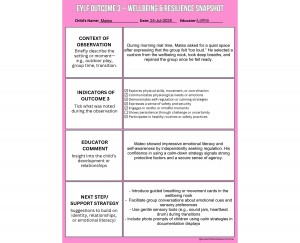
This template is to be used as an observation.
 Toddlers have a greater understanding of the world around them by this stage. Their cognitive development (also known as intellectual development and thinking skills) continues… Read More
 Infants begin to develop trust when parents begin to fulfil their needs. Such as changing an infant's nappy when needed, feeding on request and holding… Read More
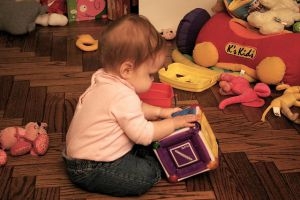 Beginning at birth the construction of thought processes, such as memory, problem solving, exploration of objects etc, is an important part of an infant’s cognitive… Read More
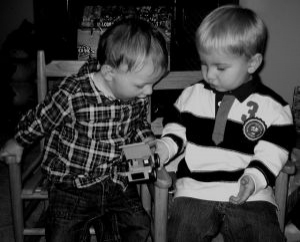 Toddlers want to do more on their own and do not like it when you begin to establish limits on their behaviour. Tantrums can become… Read More
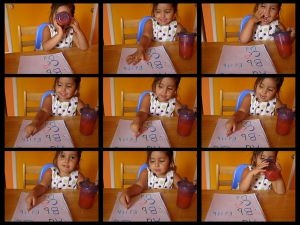 Your preschooler is now able to focus their attention more accurately and is less influenced by distractions. The intensity of questions increase as your child… Read More
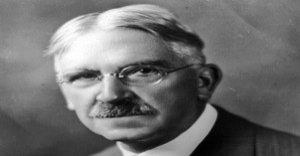 John Dewey is often seen as the proponent of learning by doing – rather than learning by passively receiving. He believed that each child was active,… Read More
 Erik Erikson developed a psychosocial theory to understand how we each develop our identities through eight stages of psychosocial development from infancy to adulthood. The… Read More
 Toddler advance and gains new skills in Gross Motor Development milestones achieved throughout earlier years. Co-ordination and challenges that could not be performed before such… Read More
 At this point preschoolers begin to interact effectively with others. Play becomes more innovative and organized and “boyfriend” or “girlfriend” begins to emerge. Preschoolers have… Read More
 From now, babies begin to identify and respond to their own feelings, understanding other's feelings & needs and interact positively with others. A baby's social and… Read More
Biting is typical behaviour of infants and toddlers that we often notice. As the children...
See more...
Piaget discovered that all children’s cognitive development progressed through four stages, beginning in infancy and...
See more...
Ellen Beate Hansen Sandseter is a Norwegian researcher and professor at Queen Maud University College...
See more...