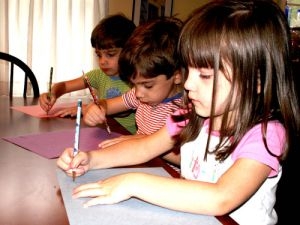
The expectation that three-year-olds should sit at a table and write their names with pencils and stencils is being reconsidered by many educators. While name recognition and writing are important milestones, current pedagogy emphasises that children develop these skills through play, sensory experiences, and creative exploration—not through repetitive table work.
Shifting Perspectives
- Developmental readiness: At age three, fine motor skills are still emerging. Pencil control and letter formation may be challenging, and pushing these skills too early can lead to frustration.
- Identity and agency: Children often begin by recognising their name visually (on labels, artwork, or cubbies) before attempting to write it. This recognition builds a sense of identity and belonging.
- Multiple pathways: Writing readiness can be nurtured through mark-making, drawing, and playful exploration of symbols, rather than formal drills.
- Encouraging interest: When children do show genuine curiosity or enthusiasm for writing their name, this interest should be encouraged. Providing supportive opportunities helps them explore literacy in a positive, self-directed way.
Alternative Approaches for Name Development
Educators can support name recognition and writing readiness through engaging, play-based methods such as
- Sensory play: Tracing names in sand, rice, or shaving foam.
- Creative arts: Painting names, stamping letters, or making playdough impressions.
- Loose parts play: Using sticks, stones, or magnetic letters to form names.
- Movement and sound: Singing, clapping, or chanting names to build phonological awareness.
- Environmental print: Displaying children’s names around the room on lockers, artwork, and group charts to encourage recognition.
Practical Tips for Educators
- Follow the child’s lead: Offer opportunities for name exploration but avoid pressure.
- Embed literacy in play: Incorporate names into everyday activities — from role play to art projects.
- Celebrate identity: Use names as a way to build belonging and pride, not just as a writing exercise.
- Document progress: Capture children’s mark-making and creative name attempts as evidence of emergent literacy.
Children will learn to recognise and write their names when they are developmentally ready. By offering sensory, creative, and play-based experiences, educators can support this journey in ways that build confidence, identity, and joy in learning.
Further Reading
Nature Name Writing
Salt Writing Names
Letter Name Match
Write My Name
Peg A Name




 The Children’s Services Award introduces a streamlined classification system and updated pay rates designed to better recognise the skills, qualifications, and responsibilities of early childhood
 The Children’s Services Award has 8 clear levels. These levels make it easier to understand where you fit, based on your experience, qualifications, and responsibilities.
 When working as a qualified early childhood teacher (with a university degree) within a service, your rate of pay will come from the Educational Services
 Diploma-qualified educators play a vital role in early childhood services, taking on responsibilities that range from supporting children’s learning and development to leading rooms and
 Certificate III qualified educators form the backbone of early childhood services, providing essential care and learning support for children across all settings. Their wages under
 Early Childhood Teachers (ECTs) play a vital role in leading curriculum and pedagogy in early learning settings. Regulation 272 of the Education and Care Services
 Discover how school readiness programs support children’s independence, confidence, and skills for a successful transition into primary school.
 When an Educator is not performing their tasks or responsibilities at best practice, these issues need to be addressed for the Educator to understand where
 Educators can maximise tax deductions by claiming classroom supplies, training, union fees, and home office costs this financial year.
 A staff appraisal is a formal, systematic process of determining and reviewing the performance of early childhood educators over a period of time, usually a