


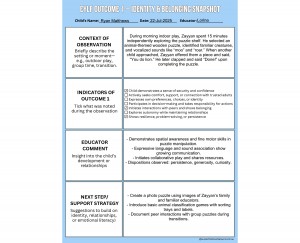
This template is to be used as an observation.

This cheat sheet offers quick, accessible reference to major theorists and concepts that shape early education practice. It includes Theories, Concepts, and Documentation Prompts, Quick Tips for Embedding Theory in Documentation, Prompts for Reflective Language, List Of Theorist Language and more.
The Early Years Learning Framework (EYLF) guides how we document, plan, and reflect on children’s learning in Australia. But with time pressures, ratio demands, and competing priorities, educators need tools that make framework integration achievable and empowering. This cheat sheet distills key EYLF elements into practical prompts and linking keywords—so teams can streamline observation cycles, make meaningful outcome connections, and stay child-focused every step of the way.

In early childhood education, observation and planning cycles are meant to illuminate learning—not drown educators in endless paperwork. Yet for many services, these cycles have become overwhelming, rigid, and detached from everyday practice. The solution isn’t to lower standards but to design systems that reflect real moments, empower educator voice, and prioritize children's growth without burning out the people guiding it.

A “Look-For” guide is a practical tool used by educational leaders and mentors to identify and reflect on key indicators of quality practice during observations, walkthroughs, or self-assessments. Think of it as a lens—it helps you focus on what matters most in a learning environment.

Here's a practical educator cheat sheet tailored for writing summative assessments in early childhood settings—designed to be clear, efficient, and aligned with EYLF outcomes. The following article provides information on Structuring Your Summary, Linking to EYLF Outcomes, Prompts to Get You Started, Expanded Prompt Starters by Theme, EYLF Outcome-Based Prompt Starters, Prompt Starters For Babies, Toddlers and Preschoolers, Tips For Writing and more.

A: In terms of best practice, not every single piece requires a long, formal reflection, but each should invite at least a moment of intentional consideration.

Here are some thoughtfully crafted critical reflection prompts to help you explore and strengthen relationships with children, aligned with Quality Area 5 of the NQS.

Here’s a thoughtful set of critical reflection questions you can use to evaluate and enrich cultural displays in your service.

The following provides practical examples of critical reflections in early childhood education, drawn from real-world scenarios.
 The Children’s Services Award introduces a streamlined classification system and updated pay rates designed to better recognise the skills, qualifications, and responsibilities of early childhood… Read More
 Children need safe and positive environments to learn and grow. To ensure this, services and educators need to ensure effective supervision at all times. The… Read More
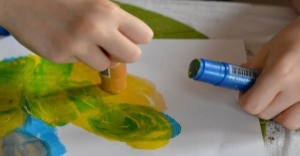 Floorbook is a documentation approach that uses a large book with blank pages for children to record different aspects of their learning in small groups… Read More
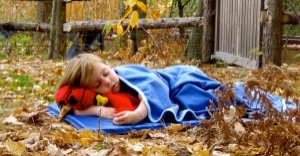 In Norway and most other Scandinavian countries, children nap in the outdoors. According, to research outdoor sleeping not only promotes better daytime sleeping, but it… Read More
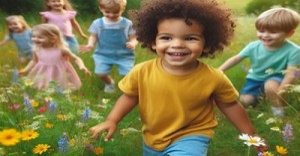 Nature programs in early childhood settings are a fantastic way to connect children with the natural world and promote holistic development. The following article provides… Read More
 From 2026, every educator covered by the Children’s Services Award will move into a new, simplified classification structure. Instead of navigating 30 different levels, educators… Read More
 Schemas are patterns of repeated behavior that allow children to explore and express developing ideas and thoughts through their play and exploration. The following article… Read More
 The following article lists 30 art and craft descriptions and links to the EYLF. These can be used as a blurb, during observations, used for… Read More
 Positive phrases play a crucial role in children's growth because they help nurture their emotional, social, and cognitive development. The following article lists 30 positive… Read More
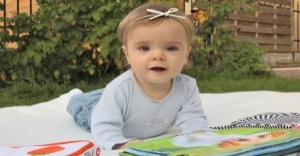 From the earliest months of life, babies thrive when given opportunities to experience the outdoors. Nature is not just a backdrop for play—it is a… Read More

A QIP display board in an early learning service is a fantastic way to make...
See more...
Young children often explore their world through touch and close contact, but rough play can...
See more...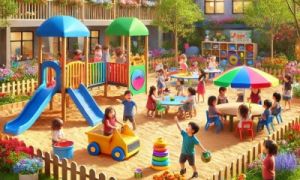
Designing engaging outdoor learning spaces offers stimulating resources and rich play-based learning opportunities that cater...
See more...