



Rest time in early childhood services should balance compliance with children’s agency. Flexible, safe, child‑centred routines support wellbeing.
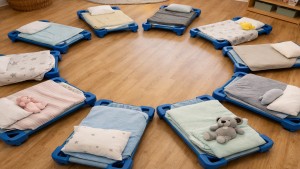
Arranging beds in a circle builds security, connection, and compliance during rest, supporting children’s wellbeing.


The Education and Care Services National Regulations emphasise that children's individual needs, including sleep and rest, must be met. The overarching goal is to ensure that children feel safe, secure, and supported during sleep and rest times. The following article provides information on Can Educators Wake Up A Child During Sleep, What To Do If Parents Want To Wake Their Child Early And The Child Is Tired, Strategies For Sleep Requests, How To Respectfully Wake Up A Child, What Is The Minimum Rest Requirement For 3 - 4 year Olds, Resources For Parents and more.

On Tuesday 21 June, a free webinar hosted by Raising Children Network, presented by Dr Fallon Cook will be conducted on a range of strategies that will help babies and toddlers who are having sleep difficulties.

Hua-Chen Wang, Lecturer in the School of Education at Macquarie University, said that they have found in research that day time nap of children, has positive effects on their literacy skills. More specifically they found that daytime naps influence the learning of letter-sound mapping and reading unfamiliar words.
There are very few research findings are available that establish a positive relationship between daytime naps pre-schoolers literacy skills. In the journal “Child Development,” a study has provided evidence that says the child who has daytime nap is sounder in learning letter-sound mapping techniques.

Early childhood services and school within NSW, will run supervised tooth brushing classes to battle high tooth decay.
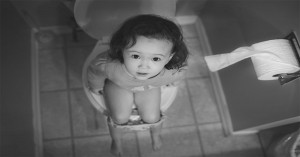
The following is a guide for Educators who are toilet training children within their room. It will provide you with information and strategies on how to assist young children during toilet training during the day in an early childhood setting.

You have a new child starting in your room, their excited, their parents are happy and the family seems to be settling in well with the centre environment. The first day has come for the child to start, parents say goodbye and then the child starts - screaming, crying, pulling, begging their parent not to leave.

You have just become parents for the first time....a baby is a wonderful miracle...you hold your baby gently in your arms as you admire your new addition to the family. You pull your baby in close to give your child a gentle kiss and then you smell something, it's strong and it smells like...Yes, it's time to change the nappy!
 A simple phrase overheard at an ECE service has sparked a wider discussion among parents, educators, and child development experts about how children learn to… Read More
 Families and educators across several Edge Early Learning centres will soon transition to new providers after administrators confirmed the sale of most services affected by… Read More
 A new investigation by ABC's Four Corners has uncovered further safety failures within Australia's childcare sector, raising fresh concerns about whether recent reforms have gone… Read More
