


In OSHC, language plays a powerful role in shaping the culture of the environment. Inappropriate language and swearing can undermine respect, safety, and inclusivity. Educators often face the challenge of balancing children’s freedom of expression with the need to maintain a positive, professional atmosphere.

Documenting for Out of School Hours (OOSH) services can be quite a task, but it's essential for ensuring quality care and learning experiences for children. The following article provides information on Documenting The Program For OOSh Services, Changes To The Documenting Requirements, Considerations In Developing Documentation, Appropriate and Relevant Documentation, Involving Children In Documentation and more.

The years between five and twelve are a time brimming with activity for children – they are developing close friendships, getting stronger in body and mind as well as widening their circle of hobbies and interests. While all this exploration makes for great learning and excitement, also sets the stage for some challenging behaviour. The following article provides information on strategies that Educators can use to promote positive behaviour in OOSH services.

National Out of School Hour Care Educators Day is the annual National day to celebrate and recognise the important role Educators play in the lives of children.
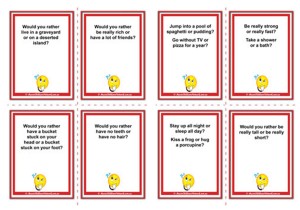
The Would You Rather Flashcards are funny and silly questions that can be asked to children. They can be used as ice breakers, brain breaks and to get to know the children a little better. These questions are to help children begin to weigh the pros and cons and make the decision that's right for them. It gives them an opportunity to think, reflect, and use their imagination while deciding between the options given.
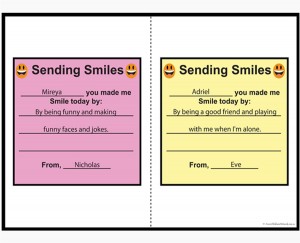
This template is for children and Educators to send smiles to one another.
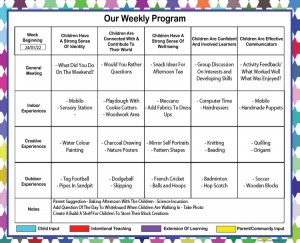
This template is for a weekly program for OOSH Services.
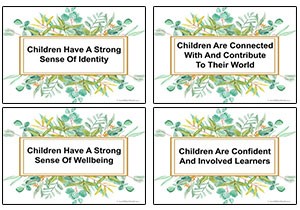
The MTOP Main Outcome Posters includes each of the main outcomes of the My Time Our Place framework for oosh services. These can be used as a display around the room to show how children achieve each outcome.
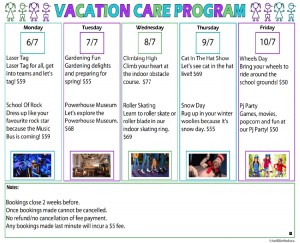
This template is for OOSH Services to list all activities, incursions and excursions during Vacation Care.

The following lists the sub outcomes, examples of evidence when children can achieve each sub outcome and how educators can promote and help children to achieve MTOP Learning Outcome 2: Children Are Connected With And Contribute To Their World.
 Open ended questions cannot be responded to with one word answers such as yes or no. These types of questions enables a child to provide… Read More
 During your child’s preschool years, an important milestone begins to emerge. This is the development of pre-writing skills. Pre-writing skills are used to encourage, develop… Read More
 An Acknowledgment of the Country is a way of showing respect for the Traditional Owners and can be given by both non-Indigenous people and Aboriginal… Read More
 Open ended materials enables children to play freely. They are objects that have no rules to follow, use or function. Raw materials that can be… Read More
 Language plays an important role in a child’s development. It enables a child to communicate effectively with their family, learn at school, socialize with friends,… Read More
 Like adults, children have to deal with their own stress in life. Moving house, starting a new school, preparing for a new sibling - these are… Read More
 Playdough is such a versatile material. It provides numerous benefits to children as they manipulate it, it is safe and soothing and provides children with… Read More
 Teaching children about sustainability enables them to appreciate and respect the natural environment. Early childhood services can provide meaningful hand on learning experiences in order… Read More
 Recycling is an important concept that teaches children to care for the environment. It encourages children to be responsible and show a growing appreciating for… Read More
 Incursions provide children with the opportunity to explore meaningful learning experiences in the comfort of their early childhood service. The following provides a directory of… Read More

Many parents feel uneasy when their child comes home from nursery with paint on their...
See more...
Encouraging children to follow instructions can be a rewarding process when approached with patience and...
See more...
In NSW, nominated supervisors and persons in day-to-day charge must complete a child protection course...
See more...