


Mark-making refers to the earliest forms of visual expression—scribbles, lines, dots, and patterns—that children create to explore ideas, communicate meaning, and experiment with representation. Within the Reggio Emilia approach, these marks are not seen as mere preparation for writing but as a powerful language of childhood, embodying thought, emotion, and identity.

Storybook baskets (sometimes called book buckets) are a powerful way to transform a simple read-aloud into an interactive, multi-sensory experience. By pairing books with props, toys, and open-ended materials, educators can help children connect more deeply with stories, practice language skills, and extend their learning through play.
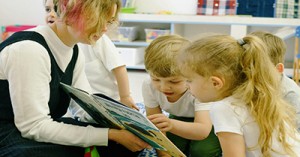
Children don’t learn to read by starting with phonics worksheets—they begin with listening, talking, imagining, and playing. Pre-reading skills emerge organically when environments are rich in language, storytelling, and joyful exploration. These foundational abilities must be nurtured before formal reading instruction begins.
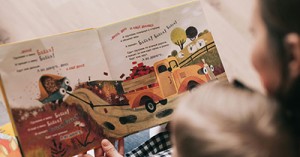
A recent report shared by 7NEWS Australia warns of a troubling trend: fewer Australian parents are reading to their children. While the headline sparks concern about declining literacy and emotional development, it risks overlooking a deeper reality—one that goes far beyond the bedtime book ritual.
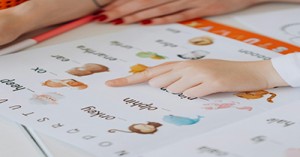
In a world where classroom outcomes are often skewed by postcode, language background, or parental education, one early predictor quietly cuts through the noise: phoneme awareness. As Brady (2020) starkly highlights, this foundational skill outranks intelligence and socioeconomic status when forecasting reading success.
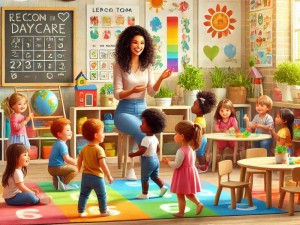
Environmental print refers to the print that children see in their everyday environment, such as signs, logos, labels, and symbols. The following article provides information on Benefits Of Environmental Print, Incorporating Environmental Print in Early Childhood Settings, Examples Of Environmental Print, Activities Related To Environmental Print, Linking To The EYLF and more.
A literacy-rich environment is one that gives children numerous opportunities to engage in emergent literacy experiences in a meaningful and authentic way. The following provides a list of literacy activities for children that can be incorporated into an emerging literacy environment.
The EYLF explains literacy as the children’s “capacity, confidence and disposition to use language in all its forms”. Thus literary includes not only talking, listening, viewing, reading and writing but a range of modes of communication including music, movement, dance, storytelling, visual arts, media and drama. The following provides information on the Literacy Rich Environment, Characteristics Of A Literacy-rich Environment, Components Of A Literacy-rich Environment, Strategies and more!

The Early Years Learning Framework identifies that positive attitudes and competencies in literacy and numeracy are important aspects
of communication and are vital for children’s successful learning. The indicators have been developed to support teachers to extend and enrich every preschool child’s numeracy and literacy learning. The following article provides information on What Are The Indicators, the Importance of The Indicators, Learning Processes, Numeracy and Literacy Indicators and more.

Hua-Chen Wang, Lecturer in the School of Education at Macquarie University, said that they have found in research that day time nap of children, has positive effects on their literacy skills. More specifically they found that daytime naps influence the learning of letter-sound mapping and reading unfamiliar words.
There are very few research findings are available that establish a positive relationship between daytime naps pre-schoolers literacy skills. In the journal “Child Development,” a study has provided evidence that says the child who has daytime nap is sounder in learning letter-sound mapping techniques.
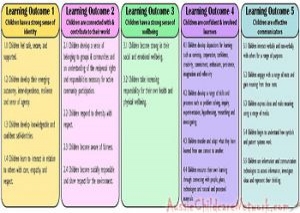 Here is the list of the EYLF Learning Outcomes that you can use as a guide or reference for your documentation and planning. The EYLF… Read More
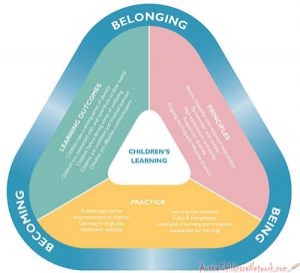 The EYLF is a guide which consists of Principles, Practices and 5 main Learning Outcomes along with each of their sub outcomes, based on identity,… Read More
 This is a guide on How to Write a Learning Story. It provides information on What Is A Learning Story, Writing A Learning Story, Sample… Read More
 One of the most important types of documentation methods that educators needs to be familiar with are “observations”. Observations are crucial for all early childhood… Read More
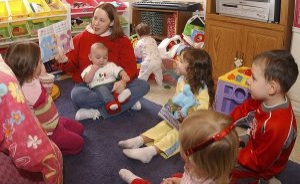 To support children achieve learning outcomes from the EYLF Framework, the following list gives educators examples of how to promote children's learning in each individual… Read More
 Reflective practice is learning from everyday situations and issues and concerns that arise which form part of our daily routine while working in an early… Read More
 When observing children, it's important that we use a range of different observation methods from running records, learning stories to photographs and work samples. Using… Read More
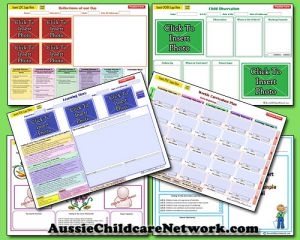 Within Australia, Programming and Planning is reflected and supported by the Early Years Learning Framework. Educators within early childhood settings, use the EYLF to guide… Read More
 This is a guide for educators on what to observe under each sub learning outcome from the EYLF Framework, when a child is engaged in… Read More
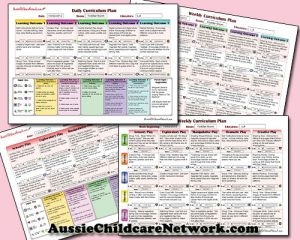 The Early Years Learning Framework describes the curriculum as “all the interactions, experiences, activities, routines and events, planned and unplanned, that occur in an environment… Read More
The ECA - Code Of Ethics is designed especially for early childhood services and based...
See more...
Kids Inventors Day is celebrated annually on January 17th. This special day honors the creativity...
See more...
A clear, practical EYLF Outcome 1 cheat sheet for educators, with examples, observation wording, and...
See more...