


The National Quality Standard includes seven quality areas, in each quality area includes standards. These standards are high-level outcome statements. Under each standard are elements that describe the outcomes that contribute to the standard being achieved within the service. The following lists the documentation services that are required to have in order to support the achievement of each quality area from 1 to 7.

Quality ratings for early educational services are determined based on the National Quality Standard (NQS) and are designed to ensure high-quality education and care for children. The following article provides information on the Quality Ratings, the Quality Areas, the Assessment Process, What Happens For Services With A Rating Of Significant Improvement Required, Displaying The Quality Ratings and more.
The aim of Quality Area 1 is to ensure that the educational programs and practices of educators are child-centred, stimulating and maximise opportunities for enhancing and extending each child’s learning and development. In the school-age care context, the aim of this Quality Area is to see that the program nurtures the development of life skills and complements children’s experiences, opportunities and relationships at school, at home and in the community. The following article provides FDC Compliance Responsibilities Of QA1, Documentation Of Assessment, How Compliance Is Monitored, Consequences For Non-Compliance and more.
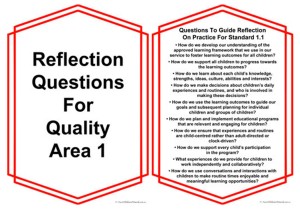
The National Quality Area Reflection Questions Posters area is to be used as a guide for reflecting on each of the standards within each area. Use the information from these questions to recognize good practise or to change and improve what is not working well. It can also be used as part of a Self-Assessment or Quality Improvement Plan. These can be used as a display within the staff room or put into a folder to assist Educators in reflecting.
Quality Area 7 - Governance and Leadership enables services to achieve the best outcomes for children and their families by creating a service with skilled and engaged workforce, sound administrative and risk management systems, well documented policies and procedures, and a safe and healthy learning environment for children.
 The Children’s Services Award introduces a streamlined classification system and updated pay rates designed to better recognise the skills, qualifications, and responsibilities of early childhood… Read More
 The Children’s Services Award has 8 clear levels. These levels make it easier to understand where you fit, based on your experience, qualifications, and responsibilities.… Read More
 When working as a qualified early childhood teacher (with a university degree) within a service, your rate of pay will come from the Educational Services… Read More
 Diploma-qualified educators play a vital role in early childhood services, taking on responsibilities that range from supporting children’s learning and development to leading rooms and… Read More
 Certificate III qualified educators form the backbone of early childhood services, providing essential care and learning support for children across all settings. Their wages under… Read More
 Early Childhood Teachers (ECTs) play a vital role in leading curriculum and pedagogy in early learning settings. Regulation 272 of the Education and Care Services… Read More
 Discover how school readiness programs support children’s independence, confidence, and skills for a successful transition into primary school.
Read More
Discover how school readiness programs support children’s independence, confidence, and skills for a successful transition into primary school.
Read More
 When an Educator is not performing their tasks or responsibilities at best practice, these issues need to be addressed for the Educator to understand where… Read More
 Educators can maximise tax deductions by claiming classroom supplies, training, union fees, and home office costs this financial year.
Read More
Educators can maximise tax deductions by claiming classroom supplies, training, union fees, and home office costs this financial year.
Read More
 A staff appraisal is a formal, systematic process of determining and reviewing the performance of early childhood educators over a period of time, usually a… Read More

The "Winter" theme is a fantastic way for toddlers to foster creativity, sensory exploration, and...
See more...
NSW Health has advised that people who are symptomatic or are household contacts of a...
See more...
The My Yearbook template is a beautifully designed resource that helps early childhood educators celebrate...
See more...