


Outdoor sandpit setups in early childhood are best designed as open-ended, sensory-rich environments that encourage creativity, social interaction, and physical development. The most effective setups combine natural materials, loose parts, and flexible structures to allow children to dig, build, and imagine freely.
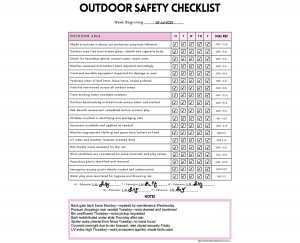
This template is used as an outdoor safety checklist.

Creating a purposeful outdoor space means more than scattering toys—it’s about crafting an environment that actively supports children’s growth. By weaving the Early Years Learning Framework (EYLF) and the National Quality Standard (NQS) into your outdoor design, you ensure every element invites meaningful exploration, skill-building, and well-being.

The following is a list of critical reflections that can help educators evaluate and continuously improve their outdoor environments in early childhood settings. These prompts are designed to inspire a thoughtful review of the outdoor environment, ensuring that it remains dynamic, inclusive, and conducive to holistic development.

Loose parts Play in outdoor areas transforms the everyday environment into a dynamic, open-ended learning space. The following article provides information on What Is Loose Parts In The Outdoor Area, Benefits Of Loose Parts Outdoors, How To Integrate Loose Parts Play Outdoors, List Of Loose Parts Play For Outdoor Areas, Innovative Activities for Loose Parts Play Outdoors, Extending On Loose Parts Play and more.
 The Children’s Services Award introduces a streamlined classification system and updated pay rates designed to better recognise the skills, qualifications, and responsibilities of early childhood… Read More
 The Children’s Services Award has 8 clear levels. These levels make it easier to understand where you fit, based on your experience, qualifications, and responsibilities.… Read More
 When working as a qualified early childhood teacher (with a university degree) within a service, your rate of pay will come from the Educational Services… Read More
 Diploma-qualified educators play a vital role in early childhood services, taking on responsibilities that range from supporting children’s learning and development to leading rooms and… Read More
 Certificate III qualified educators form the backbone of early childhood services, providing essential care and learning support for children across all settings. Their wages under… Read More
 Early Childhood Teachers (ECTs) play a vital role in leading curriculum and pedagogy in early learning settings. Regulation 272 of the Education and Care Services… Read More
 Discover how school readiness programs support children’s independence, confidence, and skills for a successful transition into primary school.
Read More
Discover how school readiness programs support children’s independence, confidence, and skills for a successful transition into primary school.
Read More
 When an Educator is not performing their tasks or responsibilities at best practice, these issues need to be addressed for the Educator to understand where… Read More
 Educators can maximise tax deductions by claiming classroom supplies, training, union fees, and home office costs this financial year.
Read More
Educators can maximise tax deductions by claiming classroom supplies, training, union fees, and home office costs this financial year.
Read More
 A staff appraisal is a formal, systematic process of determining and reviewing the performance of early childhood educators over a period of time, usually a… Read More

Weekly summaries are collective reflections that capture the learning, play, and experiences of a group...
See more...
Two protocols related to Country are important to know about in order to show respect...
See more...
Outcome 3 of the EYLF, Children have a strong sense of well-being, which reminds us...
See more...