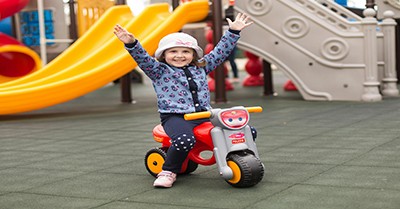
Creating a purposeful outdoor space means more than scattering toys—it’s about crafting an environment that actively supports children’s growth. By weaving the Early Years Learning Framework (EYLF) and the National Quality Standard (NQS) into your outdoor design, you ensure every element invites meaningful exploration, skill-building, and well-being.
EYLF Principles in Outdoor Environment Design
The EYLF emphasises five key learning outcomes. Below is how each outcome can guide your outdoor layout and resources.
| EYLF Outcome | Outdoor Design Consideration |
|---|---|
| Outcome 1: Children have a strong sense of identity | Spaces for solo reflection (e.g., quiet garden nook) and collaborative areas to foster belonging. |
| Outcome 2: Children are connected with and contribute to their world | Incorporate natural elements (logs, plants) and community artifacts to build sustainability awareness. |
| Outcome 3: Children have a strong sense of well-being | Design varied gross-motor zones—climbing, balancing, soft-landing surfaces—to support physical confidence. |
| Outcome 4: Children are confident and involved learners | Offer rotating loose parts (pipes, crates, shells) and provocations that encourage experimentation. |
| Outcome 5: Children are effective communicators | Create story and performance corners with open-ended props (fabric, wooden blocks) to stimulate language. |
NQS Elements for Quality Outdoor Spaces
Connecting your environment to NQS standards ensures compliance and high-quality practice. Key elements include:
| NQS Element | Focus Area |
|---|---|
| 3.1: Fit-for-purpose environment | Balance of open space and varied learning zones. |
| 3.2: Resources to support play | A mix of fixed structures and loose parts, regularly audited. |
| 3.3: Environmentally responsible | Recycling stations, native plantings, compost bins. |
| 7.1: Educational program and practice | Intentional provocations were planned and documented. |
| 7.2.1: Professional standards | Ongoing team reflection and PD on outdoor pedagogy. |
Foundations of Intentional Outdoor Design
Intentionality means being deliberate, purposeful, and thoughtful in how environments are created, used, and adapted. According to EYLF and NQS, outdoor spaces should:
- Be equally valued as indoor spaces for learning (QA1, QA3)
- Support agency, well-being, and inclusion
- Reflect children’s voices, interests, and cultural identities
- Promote sustained shared thinking and collaborative learning
Practical Strategies for Everyday Intentionality
Here’s a rich set of practical strategies for designing intentional outdoor learning environments that align with the Early Years Learning Framework (EYLF) and the National Quality Standard (NQS)—with a focus on everyday intentionality, educator agency, and child-led exploration.
Environment Setup & Positioning
-
Provocation Zones: Combine unexpected materials (e.g., clay + natural objects) to spark inquiry.
-
Flexible Layouts: Use movable logs, crates, and loose parts to allow children to redesign their space.
-
Micro-Spaces: Create quiet nooks, sensory zones, and active areas to support diverse needs.
Intentional Scheduling
-
Weather-Responsive Planning: Extend outdoor time on fine days or adapt for rain play with waterproof gear.
-
Energy Balancing: Alternate high-energy outdoor activities with calming nature-based tasks (e.g., leaf sorting, cloud watching).
-
Routine Integration: Embed literacy, numeracy, and well-being into outdoor transitions and rituals.
Intentional Interactions
-
Facilitation Over Instruction: Pose open-ended questions like “What do you notice here?” or “How could we use this stick?”
-
Encouragement & Scaffolding: Support risk-taking and resilience through gentle prompts and shared problem-solving.
-
Co-Exploration: Join children in their play, modeling curiosity and respectful engagement.
Documentation & Reflection
-
Outdoor Learning Journals: Capture photos, quotes, and sketches from outdoor experiences.
-
Child-Led Mapping: Invite children to draw or build models of their favorite outdoor spots.
-
Reflective Walks: Use walks to discuss changes in the environment, seasonal shifts, or shared discoveries.
Culturally Responsive & Inclusive Design
-
Family Voice Integration: Invite families to share outdoor traditions, plants, or stories from their cultures.
-
Sensory Diversity: Include varied textures, sounds, and smells to support neurodiverse learners.
-
Community Connection: Use local parks, gardens, or bushland to extend learning beyond the service.
-
Less Is More: Remove seldom-used resources to create clear zones that spark deeper engagement rather than visual clutter.
-
Loose Parts Rotation: Store and rotate collections fortnightly to maintain novelty and fuel curiosity.
-
Zone-Based Layout: Define areas for sand, water, natural exploration, and active play. Use simple signage or natural markers (stones, logs) to delineate each zone.
-
Natural Feature Integration: Embed logs, stones, plant beds, and a mini garden to anchor play in authentic contexts.
-
Child-Led Arrangement: Allocate a “creation corner” where children arrange materials daily, fostering ownership and spatial reasoning.
Environment Audit and Reflection Tools
-
Outdoor Environment Checklist
Ratio of open space vs. resource density
Balance of fixed equipment (climbing frames) and loose parts
Accessibility and safety under NQS supervision guidelines (Element 2.2.1) -
Vision Board Workshops
Collaboratively map desired invitations and layout changes using photos, magazine cutouts, or sketches. -
Peer Observation Rounds
Rotate small teams to observe how spaces are used and gather improvement suggestions.
Implementing these strategies ensures your outdoor environment is not just a backdrop for play, but an intentionally crafted landscape that promotes each EYLF outcome and meets NQS requirements. Regular reflection, team collaboration, and targeted PD will keep your space fresh, responsive, and deeply educational.
Further Reading
Benefits Of Outdoor Area
Outdoor Activities For Babies and Toddlers
Critical Reflection Questions For The Outdoor Learning Environment
Outdoor Experiences in Sustainability and Aboriginal Culture
Incorporating Natural Elements In Outdoor Spaces
Creating Outdoor Spaces For Children In Early Learning Services




 The Children’s Services Award introduces a streamlined classification system and updated pay rates designed to better recognise the skills, qualifications, and responsibilities of early childhood
 The Children’s Services Award has 8 clear levels. These levels make it easier to understand where you fit, based on your experience, qualifications, and responsibilities.
 When working as a qualified early childhood teacher (with a university degree) within a service, your rate of pay will come from the Educational Services
 Diploma-qualified educators play a vital role in early childhood services, taking on responsibilities that range from supporting children’s learning and development to leading rooms and
 Certificate III qualified educators form the backbone of early childhood services, providing essential care and learning support for children across all settings. Their wages under
 Early Childhood Teachers (ECTs) play a vital role in leading curriculum and pedagogy in early learning settings. Regulation 272 of the Education and Care Services
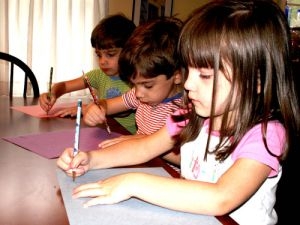 Discover how school readiness programs support children’s independence, confidence, and skills for a successful transition into primary school.
 When an Educator is not performing their tasks or responsibilities at best practice, these issues need to be addressed for the Educator to understand where
 Educators can maximise tax deductions by claiming classroom supplies, training, union fees, and home office costs this financial year.
 A staff appraisal is a formal, systematic process of determining and reviewing the performance of early childhood educators over a period of time, usually a