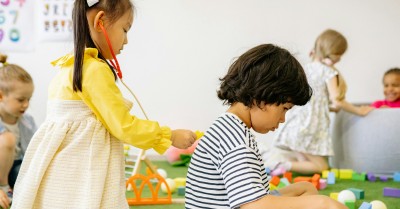
It is not uncommon for children aged 3–5 to show curiosity about bodies, including private parts. This behaviour is part of early exploration and does not carry sexual intent. However, when children seek privacy or involve peers, educators must respond with clear boundaries and child-safe practices. The goal is to guide children respectfully, without shaming, while reinforcing safety and trust.
Core Principles for Educators
- Supervision with sensitivity: Position yourself to monitor less-visible areas (corners, behind furniture, outdoor spaces) without making children feel singled out.
- Neutral language: Use calm, matter-of-fact statements like “We keep our private parts private” instead of emotional or punitive responses.
- Consistency across staff: Ensure all educators use the same language and strategies so children receive clear, predictable guidance.
- Respect and dignity: Intervene gently, redirecting children to appropriate play without embarrassment.
Practical Strategies
1. Immediate Response
- Approach calmly and say: “I can see you’re curious, but private parts are not for sharing. Let’s go play with blocks together.”
- Avoid scolding or labeling behaviour as “bad.” Instead, frame it as a boundary-setting moment.
2. Teaching Boundaries
- Use circle time to introduce concepts of “safe touch” and “private parts”.
- Example: Read a body-safety storybook and discuss: “Hands are for helping, not for touching private parts.”
- Reinforce that everyone has the right to say “no” to touch.
3. Redirecting Curiosity
- Offer sensory play (sand, water, playdough) to satisfy tactile exploration needs.
- Provide body-awareness activities like yoga stretches or “Simon Says” to channel curiosity into safe movement.
4. Creating Safe Environments
- Adjust room layout to reduce hidden corners.
- Rotate educators to supervise outdoor areas where children may seek privacy.
- Use reflective practice: document when and where behaviours occur to identify patterns.
5. Partnering with Families
- Share neutral observations with parents: “We’ve noticed the children are exploring body boundaries. We’re guiding them with safe-touch language.”
- Provide families with age-appropriate resources so the same messages are reinforced at home.
Example Scenarios
Scenario 1: Corner Play
Two boys hide behind a shelf.
- Educator response: “I can see you want to play together here. Remember, private parts are private. Let’s move to the puzzle table.”
Scenario 2: Outdoor Exploration
A group gathers in the yard away from adults.
- Educator response: Walk over, join the group, and redirect: “It looks like you’re curious. Let’s use our hands to dig in the sandpit instead.”
Scenario 3: Peer Involvement
One child initiates, others follow.
- Educator response: “We don’t touch each other’s private parts. If you’re curious, you can ask questions, but we keep bodies safe.”
Reflection Prompts for Educators
- How can I supervise without making children feel watched?
- What language do I use to set boundaries without shame?
- How do we ensure consistency across our team?
- How do we involve families in reinforcing safe-touch messages?
Children’s curiosity about bodies is normal, but educators must respond with calm supervision, consistent boundary-setting, and respectful redirection. Embedding child-safe language into everyday practice ensures children feel secure, respected, and supported in their development.
Further Reading
5 Stories For Teaching Children Body Safety and Boundaries
My Body Safety Rules Posters
Child Protection Activities For Preschoolers
How To Talk To Young Children About Child Protection
Personal Safety Theme For Preschoolers
Teaching Consent to Toddlers and Preschoolers
Simple Songs About Consent For Children
Lulu Says Yes, Lulu Says No

 Open ended questions cannot be responded to with one word answers such as yes or no. These types of questions enables a child to provide
 During your child’s preschool years, an important milestone begins to emerge. This is the development of pre-writing skills. Pre-writing skills are used to encourage, develop
 An Acknowledgment of the Country is a way of showing respect for the Traditional Owners and can be given by both non-Indigenous people and Aboriginal
 Open ended materials enables children to play freely. They are objects that have no rules to follow, use or function. Raw materials that can be
 Language plays an important role in a child’s development. It enables a child to communicate effectively with their family, learn at school, socialize with friends,
 Like adults, children have to deal with their own stress in life. Moving house, starting a new school, preparing for a new sibling - these are
 Playdough is such a versatile material. It provides numerous benefits to children as they manipulate it, it is safe and soothing and provides children with
 Teaching children about sustainability enables them to appreciate and respect the natural environment. Early childhood services can provide meaningful hand on learning experiences in order
 Recycling is an important concept that teaches children to care for the environment. It encourages children to be responsible and show a growing appreciating for
 Incursions provide children with the opportunity to explore meaningful learning experiences in the comfort of their early childhood service. The following provides a directory of