



When celebrations are well thought out—integrating community input, respecting complexity, and linking meaningfully with the curriculum—they transform into powerful learning experiences. But when they become obligatory, surface-level gestures, they risk doing more harm than good by trivializing cultural significance. Here are some reflective questions you can ask to guide your decision on which significant cultural event to celebrate in an early childhood setting.

The following lists reflection questions designed to help educators examine and enhance the learning environment in early childhood settings.

The following lists reflection questions to guide programming and planning in early childhood education.

Guidance on deepening educator reflections for practice improvement. Encourages critical reflection.

This template is a multiple-choice reflective question template for NQS Quality Area 1: Educational Program and Practice.
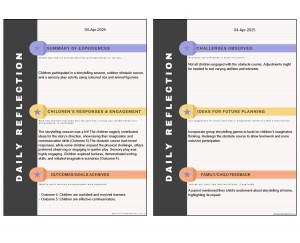
This template is used by educators to write daily reflections.

Daily reflections are a valuable practice that helps educators assess and enhance their program while fostering children's development. The following article provides information on the Benefits of Daily Reflection, What To Include In Daily Reflections, Examples and more.

Reflective teaching helps educators refine their approaches, understand children’s needs, and foster a culture of continuous growth. This guide provides discussion prompts to support meaningful reflection and professional development.

Reflective practice is essential for continuous growth in early childhood education. As a leader, fostering a culture of self-reflection helps educators refine their teaching methods, identify strengths, and enhance their impact on children’s learning experiences. Here's how to lead reflective practices effectively and an example of reflective practice in action.

Reflection is a valuable tool for personal growth and learning; critical reflection takes it a step further by promoting deeper analysis and transformative change. The following article provides information on What Is Reflection, What Is Critical Reflection, Differences Between Reflection and Critical Reflection, When To Use Reflections, When To Use Critical Reflections, Sharing Reflections and Critical Reflections With Families, Linking To The EYLF and more.
 The Children’s Services Award introduces a streamlined classification system and updated pay rates designed to better recognise the skills, qualifications, and responsibilities of early childhood… Read More
 The Children’s Services Award has 8 clear levels. These levels make it easier to understand where you fit, based on your experience, qualifications, and responsibilities.… Read More
 When working as a qualified early childhood teacher (with a university degree) within a service, your rate of pay will come from the Educational Services… Read More
 Diploma-qualified educators play a vital role in early childhood services, taking on responsibilities that range from supporting children’s learning and development to leading rooms and… Read More
 Certificate III qualified educators form the backbone of early childhood services, providing essential care and learning support for children across all settings. Their wages under… Read More
 Early Childhood Teachers (ECTs) play a vital role in leading curriculum and pedagogy in early learning settings. Regulation 272 of the Education and Care Services… Read More
 Children need safe and positive environments to learn and grow. To ensure this, services and educators need to ensure effective supervision at all times. The… Read More
 Floorbook is a documentation approach that uses a large book with blank pages for children to record different aspects of their learning in small groups… Read More
 In Norway and most other Scandinavian countries, children nap in the outdoors. According, to research outdoor sleeping not only promotes better daytime sleeping, but it… Read More
 From 2026, every educator covered by the Children’s Services Award will move into a new, simplified classification structure. Instead of navigating 30 different levels, educators… Read More

Quality Area 5 (Relationships with Children) of the NQS focuses on fostering respectful, responsive, and...
See more...
Prewriting patterns are fundamental shapes and strokes that help young children develop the fine motor...
See more...
In the fast-paced rhythm of early childhood settings, transitions often feel like logistical hurdles—moments to...
See more...