


Writing a progress report for early childhood education in Australia involves capturing a child's learning journey in a way that is clear, balanced, and informative for families.
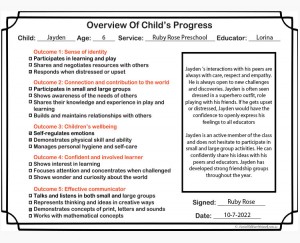
This template is to be used to detail the child's progress over the course of the year. It's great to share with families to let them know specifically how their child developed and the new skills they learnt. It can also be used as a Transition Statement for the child to be shared with the school teacher.

As Educators, there will be many instances where you will need to write about a child's behaviour. For a behaviour management plan, assessments, half-yearly or yearly reports and more. The following lists descriptive words and their meaning that can be used to describe a child's behaviour.

When completing either a half-yearly or yearly reports, its main purpose is to inform parents of their child's progress and achievements thus far. Your comments should be constructive, insightful and original.

As Educators, one of the main responsibilities is completing documentation for each child. Whether it will be completing an observation, writing a report or even communicating with parents everything needs to be written.
 The Children’s Services Award introduces a streamlined classification system and updated pay rates designed to better recognise the skills, qualifications, and responsibilities of early childhood… Read More
 Children need safe and positive environments to learn and grow. To ensure this, services and educators need to ensure effective supervision at all times. The… Read More
 Floorbook is a documentation approach that uses a large book with blank pages for children to record different aspects of their learning in small groups… Read More
 In Norway and most other Scandinavian countries, children nap in the outdoors. According, to research outdoor sleeping not only promotes better daytime sleeping, but it… Read More
 Educational leaders play a crucial role in their early childhood service by ensuring that the educational program aligns with best practices and supports the holistic… Read More
 From 2026, every educator covered by the Children’s Services Award will move into a new, simplified classification structure. Instead of navigating 30 different levels, educators… Read More
 Nature programs in early childhood settings are a fantastic way to connect children with the natural world and promote holistic development. The following article provides… Read More
 Schemas are patterns of repeated behavior that allow children to explore and express developing ideas and thoughts through their play and exploration. The following article… Read More
 The following article lists 30 art and craft descriptions and links to the EYLF. These can be used as a blurb, during observations, used for… Read More
 Positive phrases play a crucial role in children's growth because they help nurture their emotional, social, and cognitive development. The following article lists 30 positive… Read More
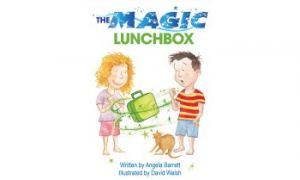
The Magic Lunchbox tells a story about when Grandma comes to visit and gives Mango...
See more...
Under the National Quality Framework, it is a requirement to have Early Childhood Teachers (ECT’s)...
See more...
The Child Safe Standards provide a nationally consistent framework to ensure that organisations working with...
See more...