


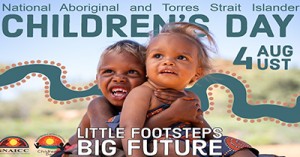
On Monday, 4 August 2025, early childhood communities across Australia will come together to honour the strength, spirit and journeys of Aboriginal and Torres Strait Islander children for National Children’s Day. The 2025 theme—Little Footsteps, Big Future—reflects the profound significance of culture, community, and Country in guiding each child’s path as they grow.

In a heartwarming episode of Playschool titled “Island Life,” features Uncle Charles Passi, a proud Torres Strait Islander, joins the show and introduces viewers to the sit-down dance “Taba Naba,” a traditional Torres Strait Islander song that celebrates island life, the sea, and community connection. This is a great opportunity for educators to learn to dance to teach children.

For babies, the Acknowledgment of Country is often expressed through sensory-rich, rhythmic, and visual experiences that help them connect to the land and its Traditional Custodians in developmentally appropriate ways. The following article provides Acknowledgment Of Country Ideas For The Babies Room.

As part of National Reconciliation Week, Early Childhood Australia is offering two free professional learning courses. Initiating a Reconciliation Action Plan: Where do I start? and Reconciliation in Children’s Education and Care: Taking the First Steps, available free until 3 June.

Introducing Indigenous Australian stories to young children is vital for fostering cultural awareness, respect, and understanding. It teaches children about the histories and realities of Aboriginal and Torres Strait Islander peoples, promoting empathy and inclusivity, and emphasizes the importance of caring for the land and respecting nature, instilling a sense of responsibility in young readers. The following article provides a list of Top 10 Popular Indigenous Australian Books For Young Children, Main Themes Explored In These Books, Linking These Books To 8 Aboriginal Ways Of Learning, and more.
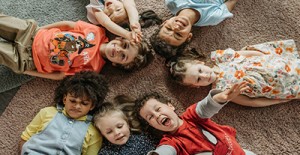
Yulunga means playing in the language of the Kamilaroi (Gamori) people of northwestern New South Wales. Suitable for preschool children, Yulunga can be used as an educational resource and as a guide to inclusive, structured sport within communities, developed by the Australian Sports Commission.
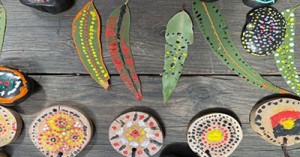
Incorporating Indigenous resources into playspaces helps create a culturally rich and inclusive environment that fosters respect, learning, and connection to First Nations traditions. Here are some ways to modify playspaces meaningfully to incorporate Aboriginal and Torres Strait Islander resources.
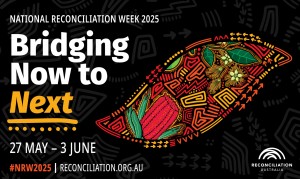
National Reconciliation Week (NRW) is an annual event, held from May 27 to June 3, that encourages all Australians to learn about the nation's shared histories, cultures, and achievements. Reconciliation Australia has free print-ready National Reconciliation Posters to download; they are also mailing printed posters by request, and free posters will be available at Officeworks nationwide.

A RAP, or Reconciliation Action Plan, is a formal framework designed to promote reconciliation between Indigenous and non-Indigenous Australians. It outlines practical actions to foster respectful relationships, create opportunities, and celebrate the rich cultures of Aboriginal and Torres Strait Islander peoples. The following article provides information on How To Develop A RAP, Examples of Initiatives To Include In A RAP, Creating A Reconciliation Action Plan, RAP Framework, Examples, and more.
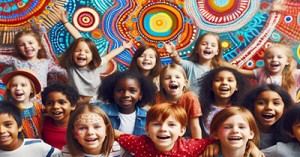
Here are several ideas for an outdoor experience that weaves together sustainability and Aboriginal perspectives/culture in a way that feels authentic, respectful, and engaging for young children.
 The Children’s Services Award introduces a streamlined classification system and updated pay rates designed to better recognise the skills, qualifications, and responsibilities of early childhood… Read More
 Children need safe and positive environments to learn and grow. To ensure this, services and educators need to ensure effective supervision at all times. The… Read More
 Floorbook is a documentation approach that uses a large book with blank pages for children to record different aspects of their learning in small groups… Read More
 In Norway and most other Scandinavian countries, children nap in the outdoors. According, to research outdoor sleeping not only promotes better daytime sleeping, but it… Read More
 Nature programs in early childhood settings are a fantastic way to connect children with the natural world and promote holistic development. The following article provides… Read More
 From 2026, every educator covered by the Children’s Services Award will move into a new, simplified classification structure. Instead of navigating 30 different levels, educators… Read More
 Schemas are patterns of repeated behavior that allow children to explore and express developing ideas and thoughts through their play and exploration. The following article… Read More
 The following article lists 30 art and craft descriptions and links to the EYLF. These can be used as a blurb, during observations, used for… Read More
 Positive phrases play a crucial role in children's growth because they help nurture their emotional, social, and cognitive development. The following article lists 30 positive… Read More
 From the earliest months of life, babies thrive when given opportunities to experience the outdoors. Nature is not just a backdrop for play—it is a… Read More
On 26 January we celebrate Australia Day. The following provides a list of activities and free...
See more...
Based on the AEDC 2024 findings, here are 5 targeted strategies services can implement to...
See more...
Here are 20 Collaborative Art Projects for Preschoolers that encourage teamwork, creativity, and fun and...
See more...