search aussie childcare network

Nature Bracelets

  • Written by 
  • Print
Nature Bracelets Lorina

Nature bracelets: a creative art activity using leaves and flowers that builds fine motor skills, sensory play, and respect for the environment.

Materials Needed:

  • Assorted leaves
  • Flowers
  • Sticks
  • Seeds
  • Stapler
  • Cardboard 
  • Glue

What to do:

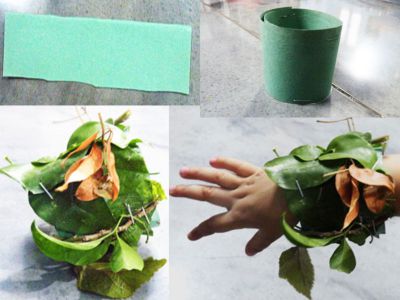
Cut the cardboard into 10 cm long thin strips.
Wrap it around the child's wrist to create a bracelet, and remove and staple it together.
Encourage child to decorate and glue the leaves onto the cardboard bangle to create their nature bracelet.
The child has now created their very own nature bracelet!

Hints and Tips:

  • If glue doesn't stick the leaves/flowers etc. you could stapler to staple them on the cardboard bracelet. This enables it too last longer than using glue as the natural items won't fall off. 
  • Aboriginal women gathered and arranged natural materials to make into tradition clothing, jewellery and cooking utensils. Clothing and jewellery that were made with these natural materials were worn by Aboriginal and Torres Strait Islander men and women during traditional ceremonies.

Extension Ideas

  • Texture exploration: Encourage children to collect and compare smooth leaves, rough bark, or soft petals.
  • Fine motor challenge: Add smaller natural items (seeds, tiny flowers) to strengthen pincer grip.
  • Pattern creation: Invite children to arrange items in repeating colour or texture sequences.
  • Sorting and classifying: Group collected items by size, colour, or type before attaching to bracelets.
  • Science link: Discuss plant parts (leaf, stem, flower) and their role in nature.
  • Seasonal exploration: Compare bracelets made in different seasons to observe changes in nature.
  • Descriptive language: Encourage words like “crunchy,” “soft,” “bright,” “fragile.”
  • Storytelling: Children narrate where they found their items and what their bracelet represents.
  • Shared reflection: Present bracelets to peers, fostering expressive communication.
  • Group collaboration: Work in pairs to collect and share natural items.
  • Cultural connections: Link bracelets to traditions (flower garlands, nature festivals).
  • Confidence building: Celebrate creations with a “nature parade” or display.
Additional Info

  • Appropriate Age: 2 year+
  • Number of Children: Individual (1), Couple (2), Few (3), Small Group (4)
  • Developmental Milestones:
    • Hand strength: Wrapping tape and pressing natural items builds grip and muscle control.

    • Coordination: Aligning leaves and flowers onto the bracelet supports hand‑eye coordination.

    • Dexterity: Picking up small petals or seeds strengthens pincer grasp and finger precision.

    • Sorting and classifying: Children group items by colour, size, or texture before attaching.

    • Pattern recognition: Creating repeating sequences of natural materials fosters early math skills.

    • Problem solving: Figuring out how to stick uneven or fragile items builds resilience and thinking skills.

    • Descriptive vocabulary: Children use words like “rough,” “smooth,” “bright,” “soft” to describe their bracelet.

    • Expressive language: Sharing stories about where items were found builds narrative skills.

    • Turn‑taking: Group collection and bracelet making encourage conversational exchanges.

    • Confidence: Wearing their bracelet proudly boosts self‑esteem.

    • Collaboration: Working in pairs to collect items fosters teamwork.

    • Environmental awareness: Respecting nature while collecting materials builds responsibility and care.

  • Play Based Learning: Exploratory Play, Creative Play
  • Interest Areas: Art and Craft, Science and Nature
  • Games Categories: Art and Craft, Fine Motor Skills, Sensory Games
  • EYLF Outcomes: Learning Outcome 2, Learning Outcome 5
  • Sub Outcomes:

    Outcome 2.4: Collecting and using natural materials fosters respect for the environment and builds awareness of sustainability.

    • Outcome 5.3: Nature bracelets become a medium for expressive art, allowing children to communicate ideas through design.

    • Outcome 5.4: Documenting bracelets through photos or digital storytelling links creative play to early ICT use.

Created On July 9, 2024 Last modified on Wednesday, August 5, 2026
Child Care Documentation App

© 2009-2026 Aussie Childcare Network Pty Ltd. All Rights Reserved.