


A rotation calendar is a powerful tool for educators to intentionally schedule and manage the refresh of learning environments, materials, and activities. When paired with a program plan, it ensures that both the physical setup and the learning journey are purposeful, engaging, and aligned with the EYLF.

In early childhood settings, meaningful moments often unfold quietly: a glance of recognition, a rhythmic sway to music, or a spontaneous giggle during water play. These moments may seem fleeting, but they carry profound developmental, emotional, and relational significance. As educators, your professional judgement is the compass that helps decide which experiences to document, reflect on, and share.
This guide is designed to support emotionally intelligent, culturally inclusive, and developmentally attuned documentation. It honours your insight, workload, and the relational depth you bring to your practice. Whether you're crafting a photo story, jotting a sensory note, or simply holding a moment in memory, this framework helps you decide what’s worth recording and why.

Practical strategies for adding group goals in childcare programs—tips, examples, and EYLF alignment to support shared learning success.
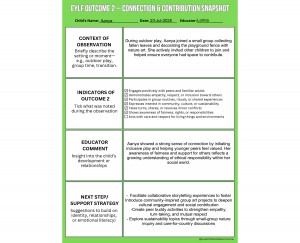
This template is to be used as an observation.
In early childhood education, observation and planning cycles are meant to illuminate learning—not drown educators in endless paperwork. Yet for many services, these cycles have become overwhelming, rigid, and detached from everyday practice. The solution isn’t to lower standards but to design systems that reflect real moments, empower educator voice, and prioritize children's growth without burning out the people guiding it.

To make the Early Years Learning Framework (EYLF) planning cycle more impactful and engaging, you can explore strategies that emphasize collaboration, creativity, and responsiveness. The folowing article provides Strategies For An Impactful and Meaningful EYLF Planning Cycle, What Is Child Centered Focus, What is Continuous Documentation, What Is Dynamic Programming, How To Include Follow Ups Into The EYLF Program, How Often Children Should Be Observed and more.

Here’s a step-by-step guide to programming and planning using EYLF. This guide also includes: How Do You Gather Information About Children's Interests, Strengths, and Learning Styles?, How Do You Analyze Observations To Identify Learning Outcomes?, How Do You Analyze Observations To Plan And Implement Further Learning Opportunities?, What Other Evidence Can Be Gathered To Intergrate Learning Opportunities Onto The EYLF Program and more.

EYLF Learning Outcome 5 focuses on effective communication, helping children develop verbal and non-verbal skills to express themselves confidently. The following article provides information on Key Learning Goals, Strategies To Support Learning Goals, Activities That Link To EYLF Learning Outcome 5, Lesson Plan Sample For EYLF Outcome 5, and more.
Outcome 4: Children Are Confident And Involved Learners in the Early Years Learning Framework (EYLF) focuses on fostering children's curiosity, creativity, and inquiry. The following article provides information on Key Learning Goals, Strategies To Support Learning Goals, Activities That Link To EYLF Learning Outcome 4, Lesson Plan Sample For EYLF Outcome 4, and more.

EYLF Learning Outcome 3 focuses on "Children Have A Strong Sense Of Wellbeing." The following article provides information on Key Learning Goals, Strategies To Support Learning Goals, Activities That Link To EYLF Learning Outcome 3, Lesson Plan Sample For EYLF Outcome 3, and more.
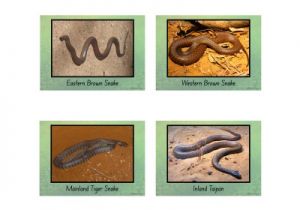
The Australian Snake Posters show images of popular Australian snakes and their names. These can...
View Worksheet...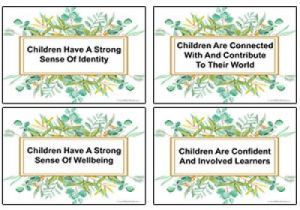
The MTOP Main Outcome Posters includes each of the main outcomes of the My Time...
View Worksheet...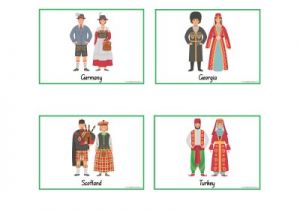
Costumes Around The World Posters show the costumes of 27 different countries. These are great...
View Worksheet...