


March is a month rich with cultural celebrations, awareness campaigns, and opportunities to connect with community. From International Women’s Day to Earth Hour, this calendar highlights events that inspire reflection, joy, and action. Whether you’re promoting inclusion, celebrating traditions, or encouraging sustainability, March offers something for everyone.

In early childhood education, celebrations like Australia Day, Lunar New Year, Diwali, Harmony Day, etc., often appear on the calendar. While these days can provide rich opportunities for learning, they can also risk becoming tokenistic if acknowledged only through surface-level activities or “because everyone else is doing it.”
The EYLF reminds us that culture is dynamic, evolving, and deeply connected to identity. Authentic celebrations should reflect the lived experiences of children, families, and communities, rather than being limited to one-off events. This explainer supports educators to move beyond tokenism and embed cultural and awareness days into meaningful, ongoing practice.

This template is to be used as a planner for cultural celebrations and events in 2026.
The following lists cultural and special events that are taking place from January to December 2026. This should help you plan and organise upcoming events and celebrations in 2026.
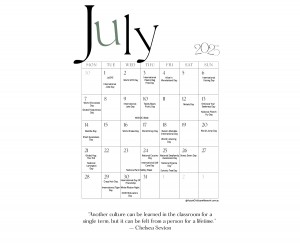
This template can be displayed in the service for the month of July 2025.
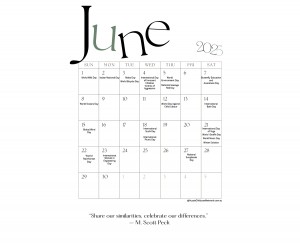
This template can be displayed in the service for the month of June 2025.

When celebrations are well thought out—integrating community input, respecting complexity, and linking meaningfully with the curriculum—they transform into powerful learning experiences. But when they become obligatory, surface-level gestures, they risk doing more harm than good by trivializing cultural significance. Here are some reflective questions you can ask to guide your decision on which significant cultural event to celebrate in an early childhood setting.
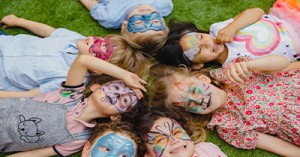
It's not necessary—or even always advisable—to celebrate every significant cultural event on the calendar each month. Instead, think of your seasonal or monthly celebrations as a curated tapestry, where each thread is carefully chosen for its relevance, impact, and ability to resonate with the children and their communities. The following article provides Key Considerations when selecting monthly celebrations, When Does It Become Tokenistic, Questions To Ask To Decide Which Significant Monthly Cultural Event To Celebrate and more.
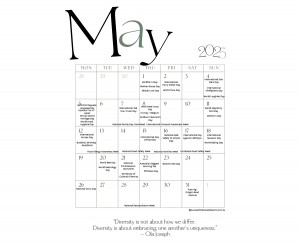
This template can be displayed in the service for the month of May 2025.
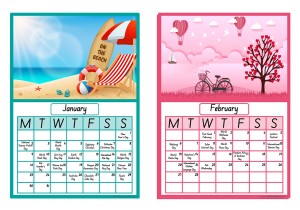
The 2023 Calendar Of Events Posters lists cultural and special events that are taking place from January - December 2023. These can be used as a display each month as a reminder of the special celebrations and events that are taking place. This should help you to plan and organise upcoming events and celebrations for 2023.
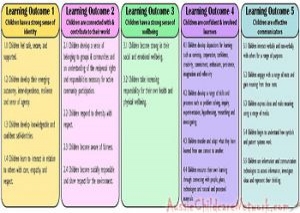 Here is the list of the EYLF Learning Outcomes that you can use as a guide or reference for your documentation and planning. The EYLF… Read More
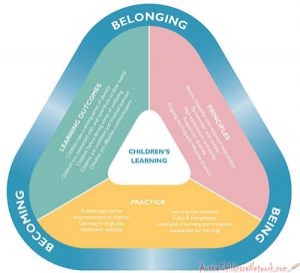 The EYLF is a guide which consists of Principles, Practices and 5 main Learning Outcomes along with each of their sub outcomes, based on identity,… Read More
 This is a guide on How to Write a Learning Story. It provides information on What Is A Learning Story, Writing A Learning Story, Sample… Read More
 One of the most important types of documentation methods that educators needs to be familiar with are “observations”. Observations are crucial for all early childhood… Read More
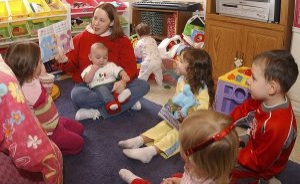 To support children achieve learning outcomes from the EYLF Framework, the following list gives educators examples of how to promote children's learning in each individual… Read More
 Reflective practice is learning from everyday situations and issues and concerns that arise which form part of our daily routine while working in an early… Read More
 When observing children, it's important that we use a range of different observation methods from running records, learning stories to photographs and work samples. Using… Read More
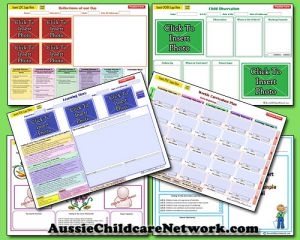 Within Australia, Programming and Planning is reflected and supported by the Early Years Learning Framework. Educators within early childhood settings, use the EYLF to guide… Read More
 This is a guide for educators on what to observe under each sub learning outcome from the EYLF Framework, when a child is engaged in… Read More
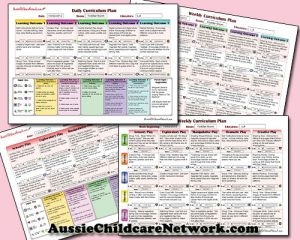 The Early Years Learning Framework describes the curriculum as “all the interactions, experiences, activities, routines and events, planned and unplanned, that occur in an environment… Read More
In early childhood education, numbers matter. Ratios often dominate policy debates, but group size, the...
See more...
Engaging farm animal activities with photos to spark creativity, learning, and play in ecec services.
See more...
To support children achieve learning outcomes from the MTOP Framework, the following list gives educators...
See more...