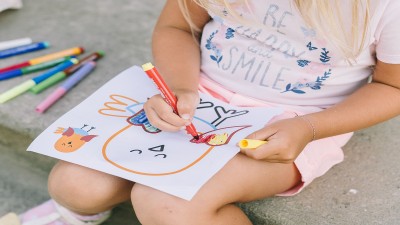
Colouring pages have long been debated in early childhood education. While some see them as restrictive, others recognise their potential when used intentionally. Rather than asking “yes or no", the question becomes: how can colouring evolve into meaningful creative, social, and developmental practices?
Colouring activities are far more than “busy work”, research shows they strengthen fine motor skills, executive function, emotional regulation, and even social collaboration when thoughtfully integrated into early childhood practice. Educators can use colouring as a springboard into storytelling, cultural exploration, and mindfulness.
Research-Backed Benefits of Colouring
-
Fine motor development: Improves grip, pressure control, and hand–eye coordination, which is foundational for handwriting and tool use.
-
Executive function: Sustained colouring supports working memory, impulse control, and planning skills.
-
Visual–spatial reasoning: Recognising boundaries and organising colour relationships strengthens STEM‑related skills.
-
Emotional regulation: Focused, repetitive colouring activates the parasympathetic nervous system, reducing stress and promoting calm.
-
Attention and self-regulation: Short “focus rounds” of colouring build sustained attention and inhibitory control.
Practical Strategies for Educators
1. Creative Expansion
-
Provide outlines (trees, houses, animals) and encourage children to add imaginative details.
-
Transition into painting, collage, or mixed‑media projects.
-
Builds confidence in moving from guided to independent creativity.
2. Storytelling Integration
-
Use colouring sheets as story prompts.
-
Example: A child colours a rocket, then invents a journey to space.
-
Supports language development and literacy links.
3. Collaborative Projects
-
Create group murals with community themes.
-
Encourage negotiation of colours and shared space.
-
Strengthens teamwork and peer learning.
4. Mindfulness & Emotional Literacy
-
Daily prompt: “Choose a colour that shows how you feel today.”
-
Use colouring as a calming routine before transitions.
-
Helps children articulate emotions visually.
5. Cultural Exploration
-
Provide sheets depicting festivals, traditions, or local symbols.
-
Invite children to share their own cultural experiences.
-
Reinforces belonging and diversity.
Example Activity Flow
-
Begin with a colouring page of a butterfly.
-
Children add patterns inspired by their imagination or cultural motifs.
-
Educator prompts: “Tell me about your butterfly’s journey.”
-
Group combines butterflies into a mural, sparking discussion on nature, migration, and identity.
How Drawing and Colouring Work Together
Drawing and colouring are deeply interconnected in early childhood practice — together they create a bridge between structured skill-building and open-ended creativity. When educators combine them intentionally, children gain both technical abilities and expressive freedom.
Drawing Builds Foundations
-
Motor control: Freehand drawing strengthens fine motor skills, pencil grip, and hand–eye coordination.
-
Symbolic thinking: Children begin to represent ideas, people, and events through marks and shapes.
-
Problem-solving: Deciding what to draw and how to represent it fosters planning and decision-making.
Colouring Enhances and Extends
-
Focus and attention: Staying within boundaries builds concentration and patience.
-
Emotional regulation: Repetitive colouring calms the nervous system and supports mindfulness.
-
Aesthetic awareness: Choosing colours develops taste, preference, and appreciation for beauty.
How They Work Together
-
Drawing first, colouring next: Children sketch their own ideas, then use colour to bring them to life. This sequence validates creativity while adding structure.
-
Colouring as a scaffold for drawing: Outlines provide a safe starting point; children gradually add their own details, moving toward independent drawing.
-
Integrated projects: For example, a child draws a house, colours it, then adds a garden. The activity evolves into storytelling and collaborative mural work.
Practical Strategies for Educators
-
Pair free drawing sessions with guided colouring sheets to balance freedom and structure.
-
Encourage children to extend colouring pages by drawing backgrounds, characters, or imaginative details.
-
Use drawing + colouring as a storytelling tool: “Draw your character, then colour their world.”
-
Introduce collaborative murals where some children draw outlines and others colour, fostering teamwork.
-
Link to EYLF Outcomes:
-
Outcome 1: Identity — children express themselves through personalised drawings.
-
Outcome 2: Connectedness — collaborative colouring builds community.
-
Outcome 3: Wellbeing — colouring supports calm and regulation.
-
Outcome 4: Learning — drawing develops problem-solving and creativity.
-
Outcome 5: Communication — combined art becomes a narrative tool.
-
Reflection Prompts for Educators
-
How can I adapt structured activities to encourage open‑ended creativity?
-
In what ways can colouring support emotional literacy in my group?
-
How might collaborative colouring projects strengthen peer relationships?
-
What cultural themes could be represented through colouring in my service?
Further Reading
Colouring Pages: Yes or No In Early Childhood Services?
Colouring Books/Pages - Forum Discussion
Free Colouring Pages